











- Ce que vous apprendrez
- Why listing your space on coworking space aggregators is worth it
- The best coworking space marketplaces to consider
- The pros and cons of being on multiple coworking space listing sites
- Simple ways to optimize your listings and turn more visitors into bookings
If you’re trying to attract more members, meeting room bookings, or day pass users, one of the easiest things you can do is make sure people can actually find your space.
Your own website should always be your primary marketing channel, but it shouldn’t be the only one. Coworking aggregators, marketplaces, and directories can help you reach people who would never have discovered your space otherwise.
I’ve also looked through conversations from coworking operators, and one thing became clear: there isn’t a single marketplace that’s best for everyone. The platforms that perform well depend on your location, the type of workspace you offer, and who you’re trying to attract.
In this guide, I’ll explain how coworking listing sites work, which platforms are worth considering, and what operators have learned from using them.
What are coworking aggregators?
Coworking aggregators are online marketplaces where people can discover and book flexible workspaces.
Instead of searching individual websites, users can browse thousands of coworking spaces, compare prices, view amenities, read reviews, and often book directly online.
Depending on the platform, people can reserve:
- Day passes
- Hot desks
- Dedicated desks
- Bureaux privés
- Salles de réunion
- Event spaces
- Training rooms
- Bureaux virtuels
Some marketplaces focus on freelancers and digital nomads, while others primarily serve businesses with hybrid teams or enterprise workspace programs.
For coworking operators, aggregators provide another way to market coworking spaces without relying entirely on organic search or paid advertising. They shouldn’t replace your own website, but they’re best viewed as another sales channel that helps fill otherwise empty space.
Why list your coworking space on marketplaces?
When people are looking for a workspace, they don’t always search for individual coworking brands. Many start on marketplace websites like LiquidSpace, Coworker, or Deskpass, where they can compare locations, amenities, prices, reviews, and availability in one place. If your space isn’t listed, you could be missing people who never make it to your coworking space website.
Marketplaces can also help you reach a different type of customer. Many larger companies now use enterprise booking platforms that let employees reserve desks, meeting rooms, or private offices while traveling or working remotely. In many cases, those users simply book through the platform their employer provides instead of searching Google for coworking spaces in your city.
“One advantage is their relationships with larger enterprise clients (T-Mobile, CVS, and other companies with hybrid workplace programs) that book workspace for employees nationwide.”
- Tammy S.
- Coworking Owners Alliance Facebook Group
Of course, no marketplace works equally well for every space. The best-performing coworking listing site often depends on where you’re located, who you’re trying to attract, and what you’re selling. Some operators generate most of their marketplace bookings through LiquidSpace, while others see better results from platforms like Deskpass or Peerspace.
A few important trends came up repeatedly:
- Results vary significantly by city and country.
- Meeting rooms and day passes often perform better than long-term memberships.
- Enterprise-focused marketplaces can introduce customers who would never have found your website.
- The best-performing platform depends on your local market.
Several operators also recommended listing on multiple marketplaces rather than relying on just one. Since many listings are free or commission-based, it’s relatively easy to test different platforms and see which ones actually generate bookings.
The key is simple: track where every booking comes from and focus on the channels that perform best for your space.
Should you list on every coworking marketplace?
Interestingly, operators don’t completely agree on this.
Many recommend listing on as many platforms as possible because it increases your visibility, creates additional backlinks to your website, and gives customers more ways to discover your space.
“Our company probably uses over 15 listing sites now. Liquidspace brings us the most revenue by far.”
- Ashley S.
- Coworking Owners Alliance Facebook Group
Others take a more selective approach.
Some operators found that large marketplace websites ranked above their own website in Google search results. Instead of bringing new customers, they ended up paying commission on people who were already searching specifically for their coworking space.
So, there’s no universal answer. If a platform consistently generates new bookings, it’s probably worth keeping. If it’s only intercepting customers who would have booked directly anyway, it may not be adding much value. Like any marketing channel, it’s worth reviewing your results every few months.
Best coworking space aggregators
Platform | Booking type | Good choice if... |
|---|---|---|
LiquidSpace | Direct bookings | You rent meeting rooms and offices |
Deskpass | Membership | You want enterprise customers |
Coworker | Booking requests | You want global exposure |
Instant Offices | Lead generation | Private offices are your focus |
Peerspace | Instant booking | You have unique spaces |
Flexspace | Ecommerce | You want online room sales |
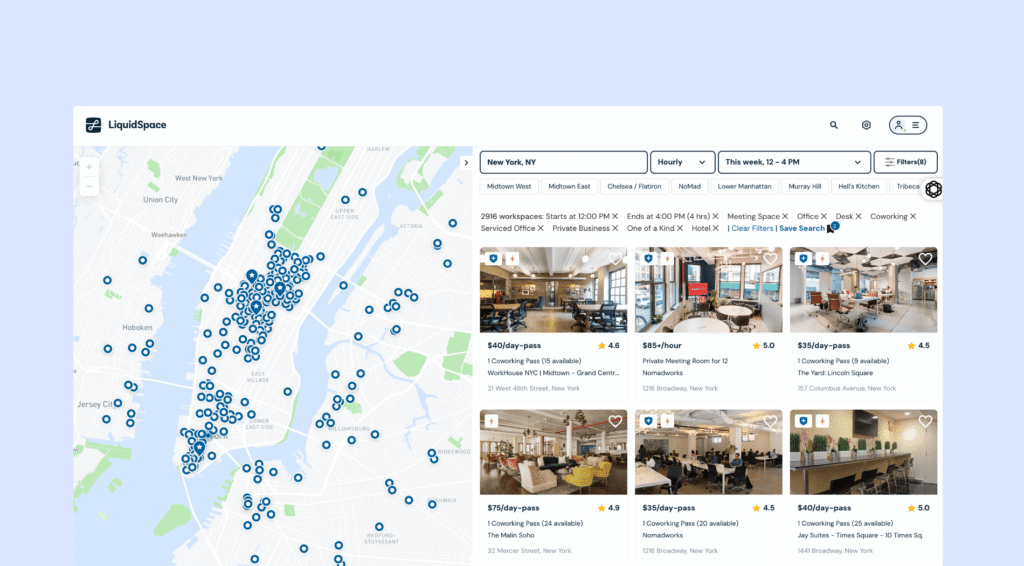
LiquidSpace
LiquidSpace is one of the largest flexible workspace marketplaces and consistently comes up as one of the strongest-performing platforms in conversations with coworking operators.
The platform focuses on:
- Day passes
- Salles de réunion
- Day offices
- Bureaux privés
One of LiquidSpace’s biggest advantages is its relationships with enterprise customers that allow employees to book workspace through company-sponsored hybrid work programs.
Many operators report that LiquidSpace generates more bookings than other marketplaces, particularly for meeting rooms and day offices. Others only receive occasional bookings, but still consider them worthwhile because they represent revenue they wouldn’t otherwise have earned.
If you’re only going to test one marketplace, LiquidSpace is often where operators recommend starting.
Deskpass
Deskpass offers a membership that gives users access to coworking spaces across its network.
Unlike traditional directories, many Deskpass users already have employer-sponsored memberships, making it an attractive source of business customers rather than one-time visitors.
Operators frequently mention strong performance for:
- Day passes
- Salles de réunion
- Corporate bookings
Several operators also noted that performance varies significantly by city. In some markets, Deskpass is one of the top booking sources, while in others it generates relatively little activity.
Coworker
Coworker is one of the largest global coworking directories, listing thousands of spaces across dozens of countries.
The platform combines searchable listings, reviews, photos, and booking requests, making it popular with freelancers, digital nomads, and remote workers.
If your space attracts international travelers or location-independent professionals, Coworker can help increase your visibility beyond your local market.
Instant Offices
Instant Offices focuses primarily on flexible offices rather than traditional coworking memberships.
Businesses can compare serviced offices, managed offices, and flexible workspaces while operators receive qualified inquiries from companies actively looking for office space.
It’s particularly useful if private offices represent a significant part of your business.
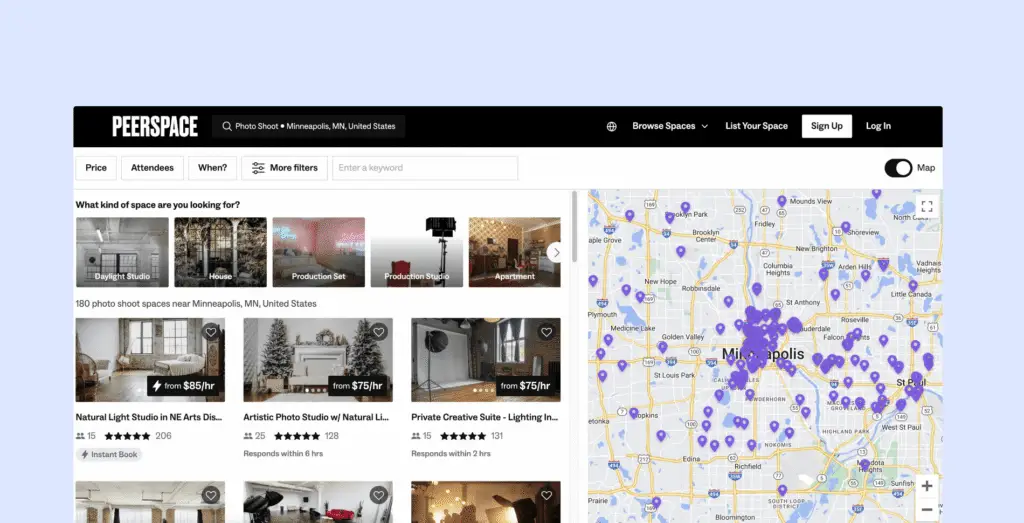
Peerspace
Peerspace is slightly different from traditional coworking marketplaces.
It specializes in hourly rentals for:
- Salles de réunion
- Event spaces
- Studios créatifs
- Podcast rooms
- Production spaces
Several coworking operators report particularly good results when listing unique spaces that appeal beyond traditional office users.
If your space hosts workshops, photoshoots, filming, or events, Peerspace is definitely worth considering.
Flexspace
Flexspace is a newer marketplace that’s receiving increasingly positive feedback from coworking operators.
Unlike traditional directories, it focuses heavily on online booking, meeting room sales, and revenue optimization tools such as dynamic pricing.
Some multi-location operators report significant increases in online bookings after adopting the platform, while smaller operators suggest the return on investment depends on how much meeting room inventory they have available.
If your business relies heavily on meeting room revenue, Flexspace may be worth exploring.
Other marketplaces worth considering
The biggest takeaway from speaking with coworking operators is that marketplace performance is highly local. A platform that’s popular in one city may generate very few bookings somewhere else, so it’s worth testing a few options to see what works best for your space.
Here are some additional marketplaces worth exploring:
- Upflex – Best for reaching enterprise customers and companies running hybrid work programs.
- Gable – Focuses on corporate workspace bookings, particularly for distributed teams.
- FlowSpace – A flexible workspace marketplace offering on-demand desks, offices, and meeting rooms.
- Office Freedom – Specializes in serviced offices and flexible workspaces around the world.
- Office Hub – A popular office marketplace with a particularly strong presence in the Asia-Pacific region.
- Workthere – Helps businesses compare and find flexible office space across major cities.
- Hubble – Well-known in the UK for flexible offices, coworking spaces, and meeting rooms.
- PLURIA – A growing European platform focused on hybrid work and on-demand workspaces.
- Letswork – A membership-based network of coworking spaces, hotels, and cafés with a strong presence in the Middle East and an expanding footprint in Europe.
Don’t worry about finding the “perfect” marketplace straight away. The best platform in London may not be the best platform in Chicago, Sydney, or Berlin, so it’s worth experimenting.
Are there any downsides to using coworking space aggregators?
Coworking marketplaces can be a great way to attract new customers, but like any sales channel, they’re not without their trade-offs.
Commission fees
Most marketplaces make money by charging a commission, referral fee, or subscription. If they’re bringing you customers who wouldn’t have found your space otherwise, that’s usually a fair exchange.
The important thing is to make sure the value of those bookings outweighs the cost. Track how much revenue each platform generates and compare it to the fees you’re paying.
SEO and branded searches
Large marketplace websites often rank very well in Google. On the one hand, that’s great because it gives your coworking space another opportunity to be discovered.
On the other hand, some operators have found that marketplace listings started appearing above their own website for branded searches. Instead of bringing in new customers, the marketplace became the middleman for people who were already looking for their space.
The important thing is to make sure the value of those bookings outweighs the cost. Track how much revenue each platform generates and compare it to the fees you’re paying.
“We have now extracted ourselves massively from the vast majority as all that was happening is direct inquiries looking for our business were going via their platforms because they were appearing above us in Google search and we were losing organic clients who then had a terrible user experience of joining our business and were having to pay brokerage fees for business that we would’ve got direct anyway.”
- Kate D.
- Coworking Owners Alliance Facebook Group
More competition
On your own website, you control the customer journey. On a marketplace, your space appears alongside (sometimes hundreds) of competitors.
That makes it even more important to have great photos, a clear description, and an up-to-date listing that shows why someone should choose your space.
Keeping listings up to date
If you decide to list on several marketplaces, you’ll need to keep each profile updated. Prices, coworking space amenities, opening hours, availability, and photos should all stay consistent, especially if you’re accepting online bookings.
À propos :
How to create coworking space listings that get more bookings
Creating a coworking space listing is easy, but getting people to click “Book now” takes a little more work.
The operators I came across all had one thing in common: they treated their marketplace listings like an extension of their own website, not something they set up once and forgot about.
Here are a few simple ways to improve your chances of getting more bookings:
- Use high-quality photos. Show every type of workspace you offer, including coworking areas, private offices, meeting rooms, and shared spaces. Bright, professional photos make a huge difference.
- Explain what makes your space unique. Maybe it’s your friendly community, central location, great coffee, free parking, podcast studio, or beautiful design. Give people a reason to choose your space over dozens of others.
- Keep your listing up to date. Make sure your pricing, opening hours, amenities, and availability are always accurate. An outdated listing can quickly put people off.
- Don’t overlook your meeting rooms. Many operators say marketplaces generate more demand for meeting rooms, day offices, and day passes than long-term memberships, so make those spaces easy to find.
- Refresh your listing every so often. Upload new photos, update your description, or highlight new amenities. Some operators believe active listings get better visibility, and it also reassures potential customers that your information is current.
- Track where your bookings come from. Don’t assume every marketplace performs the same. Keep an eye on which platforms generate the most inquiries, bookings, and repeat customers, then focus your time on the ones that deliver results.
- Turn first-time visitors into repeat customers. If someone discovers your space through a marketplace and enjoys their experience, encourage them to book directly with you next time. It’s a great way to build long-term relationships while reducing commission costs.
A little maintenance goes a long way. No marketplace will fill your space on its own, but a well-maintained listing can become another reliable source of bookings. Keep testing different platforms, measure the results, and invest more time in the ones that consistently bring you new customers.
Coworking aggregators FAQs
Should I list my coworking space on multiple marketplaces?
In most cases, yes. Many coworking operators recommend testing several marketplaces rather than relying on just one. Different platforms perform better in different cities, and each attracts a slightly different audience. Track where your bookings come from and keep investing in the platforms that consistently generate results.
Which coworking marketplace is best?
There’s no single platform that’s best for every coworking space. Based on operator feedback, LiquidSpace has one of the strongest overall reputations, particularly for meeting rooms, day offices, and enterprise bookings. Deskpass is another popular choice for corporate teams, while Peerspace is a great fit for event spaces and creative studios.
Do coworking marketplaces charge commission?
Many do, but pricing varies by platform. Some charge a commission only when a booking is completed, while others use monthly subscriptions, referral fees, or custom pricing. Always check the pricing model before signing up so you understand the total cost.
Which types of spaces perform best on marketplaces?
Based on operator experiences, marketplaces tend to perform best for short-term bookings such as meeting rooms, day offices, day passes, and event spaces. Long-term coworking memberships are often acquired through your own website, referrals, or local marketing.
Do coworking marketplaces help with SEO?
They can. Listing your space on well-known marketplace websites can increase your online visibility and create additional backlinks to your website. However, some operators have found that large marketplaces rank above their own website in Google search results, so it’s worth monitoring whether each platform is bringing you genuinely new customers.
How often should I update my listings?
It’s a good idea to review your listings regularly. Update your photos, pricing, amenities, opening hours, and availability whenever something changes. Even if nothing major has changed, refreshing your listing every few months helps make sure potential customers always see accurate information.