






Meeting room booking software pricing can get confusing fast.
Two pricing pages can look very similar, but once you actually factor in rooms, users, locations, integrations, and “must-have” features, the final room booking system cost can end up very different.
This guide is here to help you understand what meeting room booking software actually costs, how different pricing models work, and what usually makes the price go up. We will break down the most common pricing approaches, show real examples, and explain what to watch out for before you commit.
By the end, you should have a much clearer idea of what to budget for and how to compare room booking tools. Shall we?
Room booking software pricing guide
Why meeting room booking pricing can feel confusing
Most of the confusion comes from one big thing: vendors have different pricing models.
Some tools charge per employee (so the bill grows with headcount). Others charge per room or per bookable space (so the bill grows with your workplace footprint). And some platforms do not publish pricing at all, so you can’t compare without sitting through sales calls.
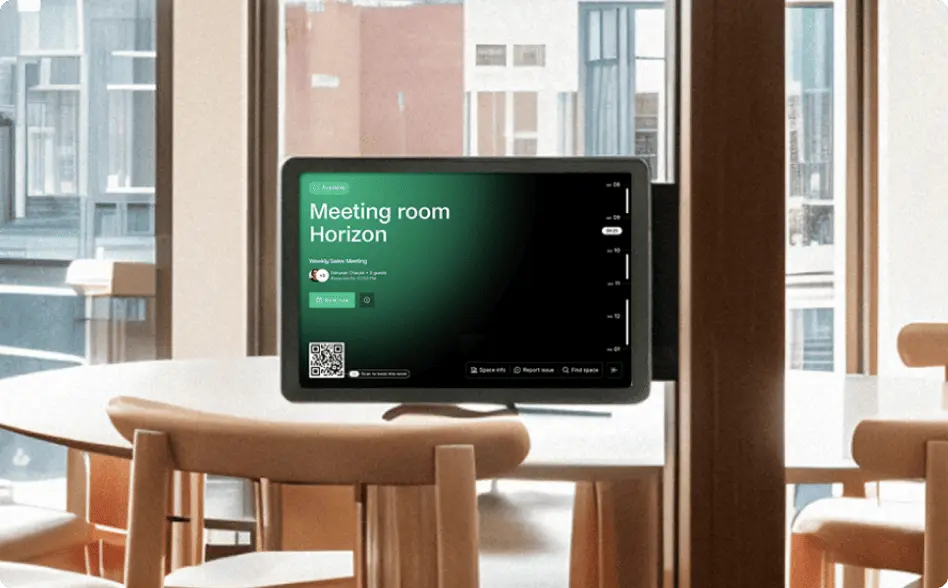
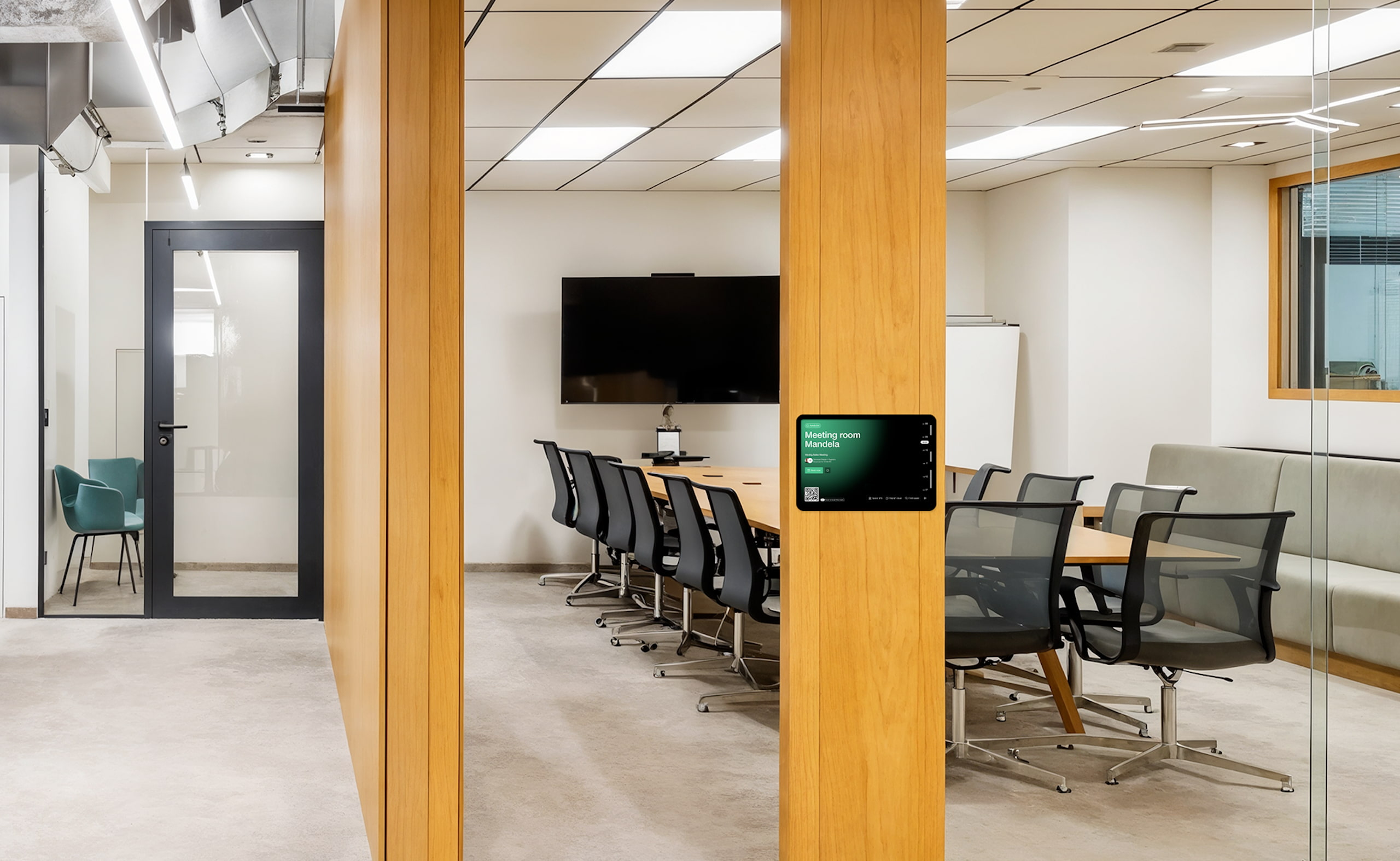
On top of that, room booking is often bundled with other workplace modules like desks, visitors, requests (catering, AV, IT tickets), room displays, and analytics. The room booking price you see may not include the parts you actually need day to day.
Most common room booking software pricing models
#1 Per room or per space pricing (resource-based)
You pay based on the rooms (or “spaces”) you make bookable, not the number of employees who might log in.
This is often easier to budget for in hybrid offices because headcount can change, while the number of rooms usually stays the same.
What to watch for:
- Minimum monthly fees (even if you only have a few rooms)
- Tier jumps if “spaces included” are bundled into plans
- Extra charges for add-on modules (analytics, displays, visitors)
Examples from the top meeting room booking solutions:
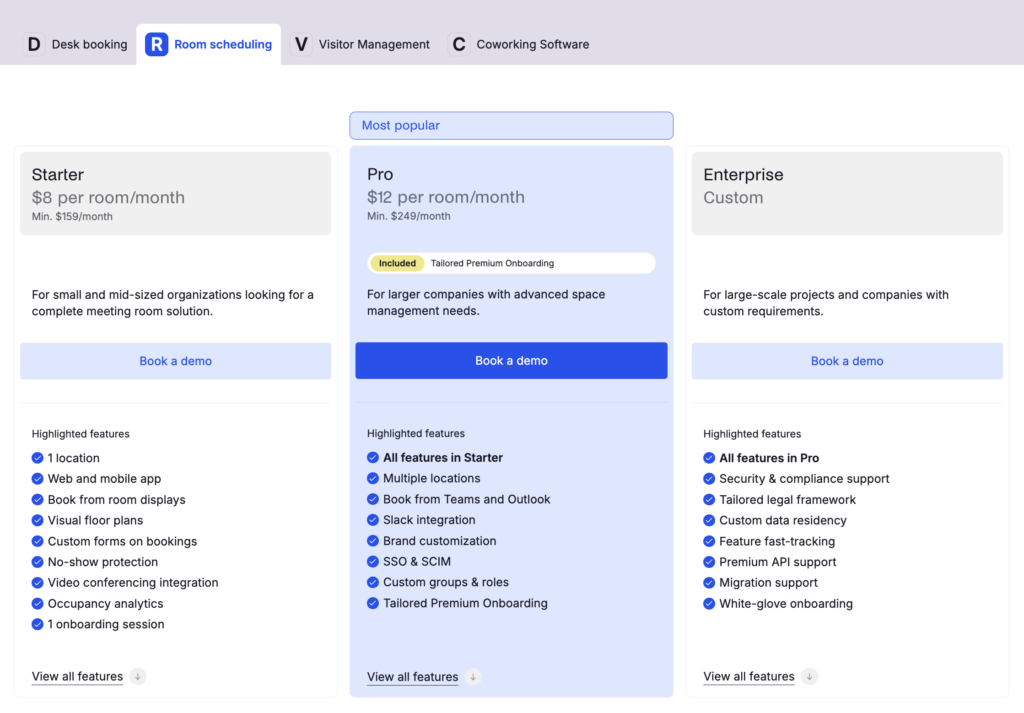
- Officely Meeting Rooms: $12 per space per month
- Envoy Reservations: $60 per bookable resource a year
- Skedda: priced in tiers that include a set number of “spaces” (for example, $99 to $199/month)
- Archie: Room booking software starts at $8 per room per month, with a $159/month minimum
#2 Per user (or per active user)
You pay for each employee (or active user) who can book rooms.
This can be great for smaller teams. But it often gets expensive as you grow, especially if lots of people only come in sometimes but still need access.
What to watch for:
- How the vendor defines “user” (licensed user vs active user)
- Whether room booking is included in the plan you’ll actually need
- Whether Teams, Outlook add-ins, SSO, admin roles, or approvals require higher tiers
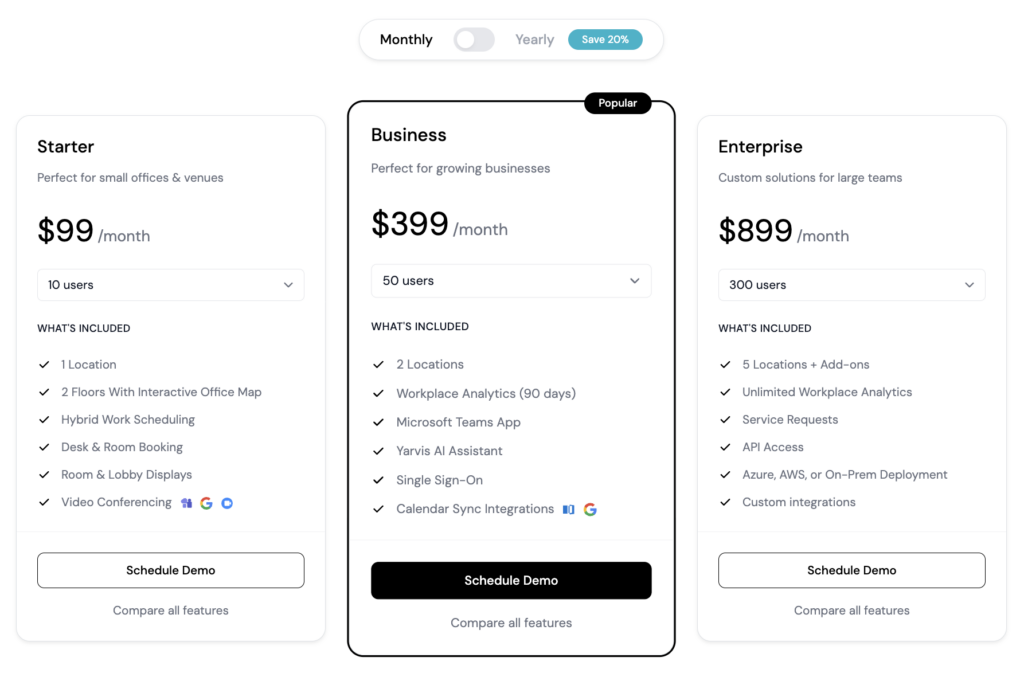
Room booking system cost examples:
#3 Quote-based enterprise pricing
The vendor does not list public prices. You book a demo and get a custom quote based on size, locations, and modules.
This can be fine for large rollouts, but it makes comparisons harder and usually means a longer buying process.
What to watch for:
- Setup fees
- Paid onboarding
- Floor plan creation fees
- Add-ons for analytics and integrations
- Contract terms (annual commitments, minimums)
Room booking system examples:
What usually makes the price go up (no matter the vendor)
- Locations and floors: Multi-location support often pushes you into higher plans. Some tools also limit the number of floors or maps per plan.
- Third-party integrations: SSO, SCIM, directory sync, and deeper Teams or Slack workflows often sit behind higher tiers.
- Admin controls and policies. Things like roles, approvals, booking windows, buffers, restrictions, no-show protection, and advanced permissions are often “paid upgrades.”
- Analytics and reporting. Basic meeting room occupancy stats are common, but deeper workplace analytics usually cost extra.
- Add-on modules. Many platforms charge extra for workplace requests (catering, AV, IT tickets), room displays and hardware support, AI assistants or advanced automations.
How to compare meeting room booking software pricing
#1 Price your real setup (not the “starting at” price)
The number on the pricing page is usually the best-case scenario. What matters is what you would actually pay once your office is fully set up.
Figure out the basics:
- How many meeting rooms you want to make bookable (and any other “spaces” like focus rooms, pods, training rooms, or boardrooms).
- How many people need access to book rooms. If the tool charges per user, estimate “real users” vs “everyone in the company.”
- How many locations and floors you need. Multi-site support often changes the plan you need.
- Which booking methods matter (web, mobile, Slack, Teams or Outlook, room displays, kiosks, QR codes).
- Which policies you need on day one, like buffers, booking windows, approvals, and restrictions.
💡 Do a simple “month 1” estimate and a “month 12” estimate. A tool can look fine today but get expensive fast once you add more rooms, offices, or teams.
#2 Check what’s included vs gated (this is where surprises happen)
Two tools can cost the same “on paper,” but one includes the features you actually need, while the other pushes them into higher tiers or add-ons.
Common features that are often gated:
- Check-ins + auto-release (no-show protection). Without this, rooms still get blocked by ghost meetings.
- Teams and Outlook booking (or calendar add-ins). Some tools sync calendars, but only higher plans let users book directly inside Teams/Outlook.
- SSO, SCIM, and directory sync. These are often “enterprise” features, but many IT teams need them even for mid-sized rollouts.
- Admin roles, permissions, and approvals. If you manage shared rooms across departments, this matters a lot.
- Analytics that are actually useful. Some plans only include basic dashboards, short history windows (like 30–90 days), or limited exports.
#3 Double-check with vendors (so you can compare fairly)
Here’s a stronger checklist you can send to vendors or use on demo calls. It helps you avoid vague answers and makes apples-to-apples comparisons easier.
✅ What is pricing based on? Per user, per room/space, per location, or a mix?
✅ What counts as a “user” and what counts as a “space”? Is a “user” any employee, only active users, or only licensed users? Is a “space” only meeting rooms, or also phone booths, focus pods, and other bookable areas?
✅ Are there minimums or commitments? Monthly minimum fees, annual contracts, or minimum user/space counts?
✅ Which plan includes the features we need to go live? Specifically: check-ins + auto-release, recurring meetings, buffers, approvals, admin roles, and room equipment filters.
✅ Which plan includes key integrations and security? SSO, SCIM, directory sync (Entra ID/Okta/Google), Teams/Outlook add-ins, Slack, and calendar sync.
✅ Are analytics and exports included, and how much history do we get? Do we get CSV exports? API access? Unlimited history? Custom reports?
✅ Are there setup fees or paid onboarding? Maps/floor plans, implementation help, training, hardware setup, integrations.
A simple room booking system cost comparison
As an example, here’s an estimated monthly pricing for 20 meeting rooms and 300 employees (USD):
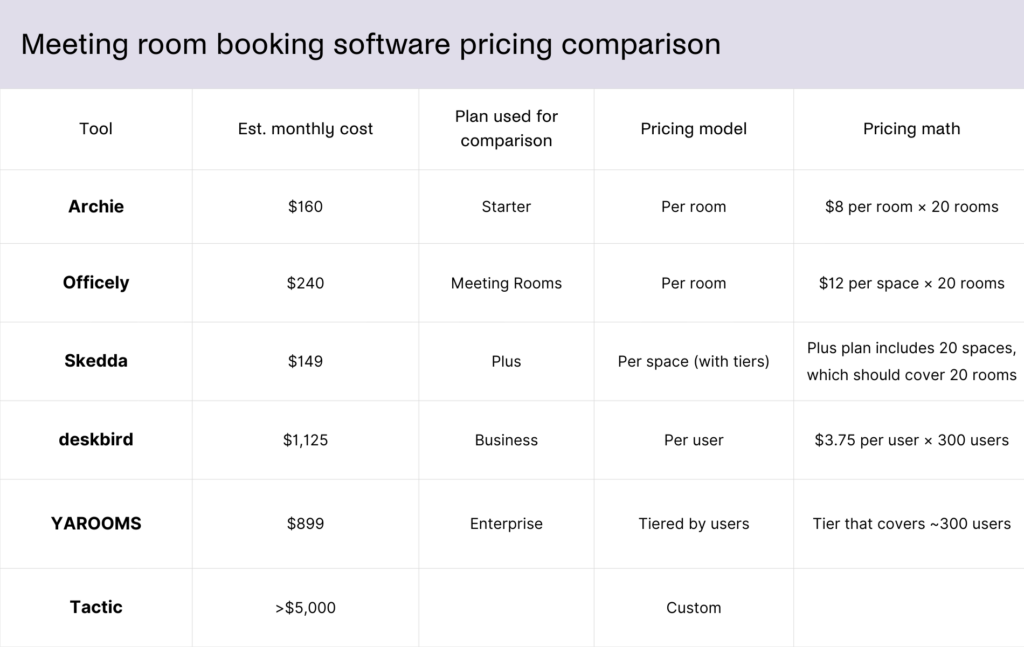
💡 These are list-price estimates. Real totals can change with add-ons, annual billing discounts, plan limits, and setup fees. If a vendor uses custom quotes, ask for a full estimate upfront so you can compare tools fairly.
When each pricing model usually makes the most sense
- Resource-based pricing is usually best when you have lots of employees and a fixed number of rooms, especially in hybrid offices.
- Per-user pricing is usually best for smaller teams where most employees will actively use the tool often.
- Quote-based pricing is usually best when you need complex rollouts across many locations, custom security requirements, or heavier workplace operations workflows.
If you want a room booking system that’s easy to use, quick to roll out, and easy to budget for, Archie is a strong pick for most modern offices. It charges per room, not per employee, so your cost stays tied to the spaces you manage, not your headcount.

Berenika Teter
Archie's Content Manager, fueled by filter coffee and a love for remote work. When she’s not writing about coworking spaces and hybrid workplaces, you can probably find her exploring one.