









TL;DR: Key statistics on flexible working
Flexible work isn’t a nice bonus anymore. For a lot of office and knowledge workers, it’s something they simply expect from their employer. When you look at the big surveys and labor market data from 2024–2025, a few clear themes keep coming up:
- For jobs that can be done remotely, most people now work in a hybrid or fully remote setup. And most of them want to stay hybrid, not go back to five days in the office or switch to 100% remote forever.
- Employers have adjusted. Roughly two-thirds of US companies and about nine in ten UK organizations now offer some kind of flexible working. At the same time, return-to-office rules are getting tighter, and minimum office days are slowly increasing.
- Flexibility is closely tied to retention. Across several surveys, around three-quarters of workers say flexibility in when and where they work influences whether they stay with their employer. About half of current remote workers say they’d be unlikely to stay if they lost the option to work from home.
- The idea that “flexible work kills productivity” doesn’t really match the data. Many employers report that productivity has stayed the same or improved with more flexibility, and companies with fully flexible policies have grown their revenue faster than those with strict office-only rules.
- The focus is shifting from where people work to when they work. Workers are blocking out focus time on their calendars, “microshifting” their day into shorter chunks, and pushing back on very early or very late meetings.
In short, flexible work is here to stay, but it’s evolving. Hybrid is now the default model, expectations are high, and poorly designed policies can cost organizations real talent, well-being, and performance.
Guide to flexible working statistics
What is “flexible working”?
When we talk about “flexible working” in this article, we are not just talking about working from home a couple of days a week. Most research now uses the term to cover three big areas of flexibility: where you work, when you work, and how much you work.
CIPD sums it up nicely: flexible working means any arrangement where there is some flexibility over how long, where, when, and at what times people work, usually in a way that aims to benefit both the employee and the organization.
Different reports use slightly different labels, but they are all pointing to the same big shift. Whether the focus is on hybrid work in Europe, flexible hours in the UK, or microshifting in US hybrid teams, the common goal is to give employees more control over their time and place of work, within clear boundaries that still let the business run smoothly.
Adoption: How common is flexible working nowadays?
If a job can be done remotely in the US, some kind of flexibility is now standard rather than special.
Pew Research Center finds that among employed adults whose jobs can be done from home, about 75% are working from home at least some of the time. Only a minority are now fully tied to the workplace.
Gallup’s hybrid work indicator shows a very similar picture when examining “remote-capable” employees. Their recent summaries put the split at roughly half working hybrid, about three in ten fully remote, and roughly one in five fully on-site.
So when you see big headlines about “everyone going back to the office”, they mostly talk about that last slice of workers in remote-capable jobs who are still, or again, fully on site. For the majority of people whose work can be done away from the office, some level of flexibility is already built in and very much expected.
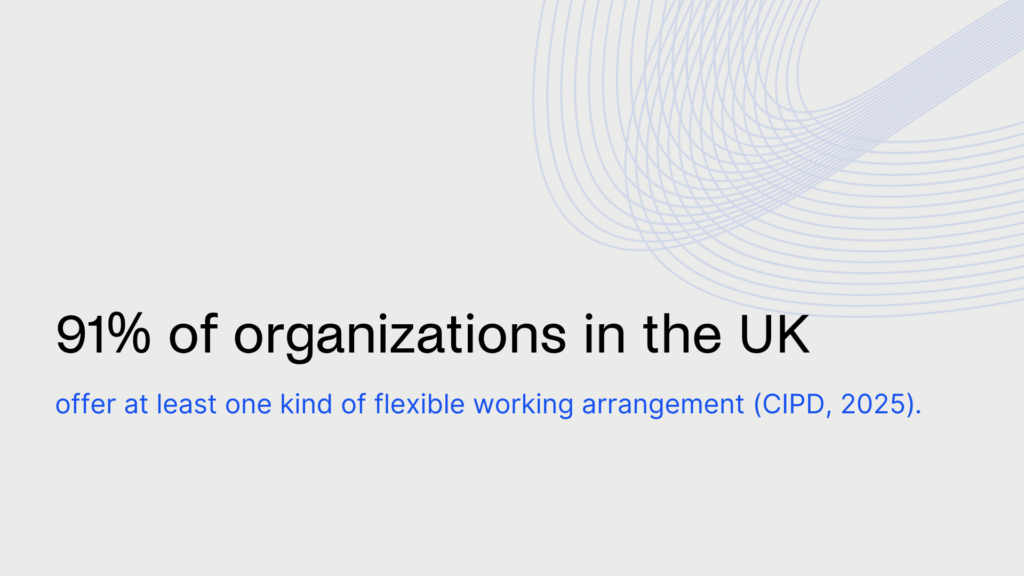
Outside the US, the overall direction is the same, but the numbers and pace are a bit different by region. On paper, the UK is one of the most flexible markets for work. The CIPD’s report finds that 91% of organizations offer at least one kind of flexible working arrangement. The most common options are working from home on a regular or ad hoc basis, part-time hours, and informal flexibility agreed with a direct manager.
If you group home and hybrid options together, the same survey shows that around 88% of employers offer some form of home or hybrid working. For many organizations, this is now part of the standard package, not something reserved for a small group of office workers.
CIPD also asked how many employees actually have access to flexibility. Just over half of employers, 58%, say that all or most employees in their organization can work flexibly in some way. That still leaves about two in five organizations where only some or a few employees have that option, which creates obvious fairness questions.
What about more specific flexible working arrangements? Statistics show that these are still quite niche. For example, around 28% of organizations offer some kind of four-day work week, usually in the form of compressed hours rather than shorter weeks on the same pay. Job-sharing, term-time working, and similar options exist, but only in a minority of workplaces.
So the UK picture is: almost everyone offers something, but the menu of flexible options is still uneven once you look beyond basic home or hybrid working.
Employers and job postings
If we shift from policy to what companies are doing in the market, two patterns stand out.
First, most firms now offer at least some location flexibility in their official policies. The Flex Index, which tracks workplace rules across thousands of US companies, reports that flexibility has become the norm. Its Q3 2025 summary shows that around two-thirds of firms have some kind of work-location flexibility written into their policies, and roughly one-third still expect employees to be fully in the office.
Second, new job postings clearly reflect a move away from “office only” roles, even if on-site jobs are still the majority. Robert Half’s research looks at professional job ads across the US. For Q3 2025, they find that about 24% of new roles were hybrid, 12% were fully remote, and 64% were fully on-site.
A couple of years earlier, fully on-site roles were much more dominant. In 2023 data, Robert Half and related summaries describe fully in-office postings in the high 60s to low 80s as a share of new roles, with hybrid in the mid-teens and remote in the low teens. By 2025, that has shifted to roughly one in three new jobs, including some remote work, either hybrid or fully remote.
Taken together, the adoption story in 2025 looks like this:
- For remote-capable jobs, hybrid and remote work are now the default, not the edge case.
- On the hiring side, more and more new roles come with at least some flexibility built in, even if fully on-site jobs remain the largest single group.
Preferences: What do workers actually want?
If the adoption data tells us how people are working today, preference data tells us what they wish their work life looked like. Across several big surveys, the story is very consistent: most people want hybrid. They do not want to be forced back into the office full-time, but they also do not all want to be fully remote forever.
Preferred work models
Gallup’s hybrid work indicator is very clear on this. Among U.S. employees in jobs that can be performed remotely, about six in ten say their ideal setup is hybrid, around one-third would prefer to be fully remote, and less than one in ten would choose to be fully on-site.
Robert Half sees the same pattern when they look at job seekers. In their 2025 remote work trends data, roughly half of professionals say hybrid is their top choice, about a quarter say they would rather be fully remote, and only 19% say an in-office job is their first choice.
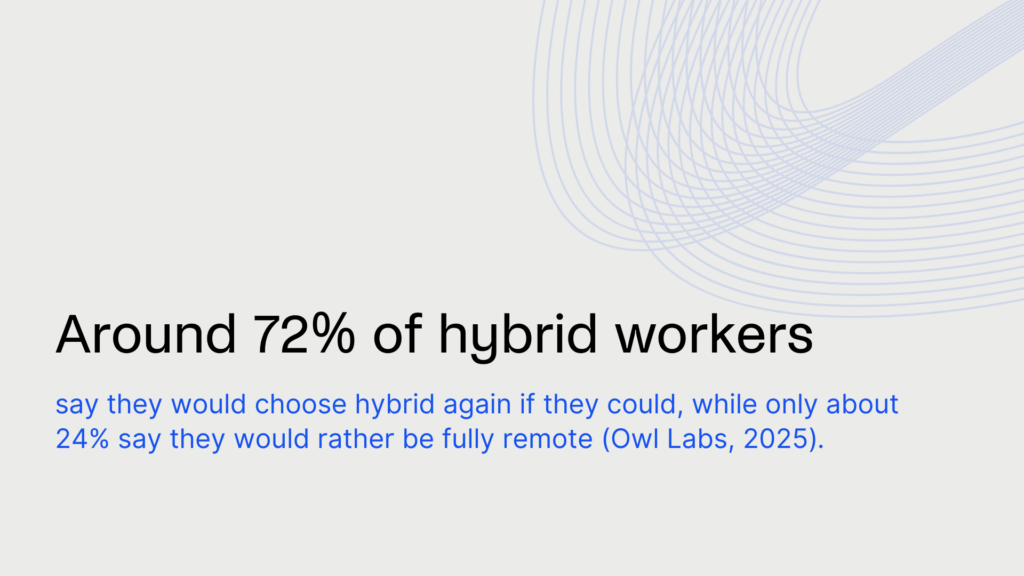
When you look at workers who are already hybrid, most of them want to keep it that way. In Owl Labs’ State of Hybrid Work 2025 report, around 72% of hybrid workers say they would choose hybrid again if they could, while only about 24% say they would rather be fully remote.
Even people who barely ever work from home today often want more flexibility. Pew Research Center finds that among workers who rarely or never work from home, about 63% say that if they could choose, they would like to work from home most or some of the time.
Put together, this shows that flexible working is not just a “remote worker wish list.” It has become a baseline expectation even for many people who are still mostly on-site. For most remote-capable workers, the sweet spot is a mix of home and office, not one extreme or the other.
Work flexibility vs pay, perks, and other factors
Money still matters a lot, but flexibility is now right behind it.
In Owl Labs’ 2025 survey of U.S. workers, 91% say compensation is very important, 89% say having a supportive manager is very important, and 89% say benefits matter. These are the classic pillars. Immediately after that, though, you see flexibility show up in the rankings: 83% say being able to work flexible hours is important, 82% say flexible days are important, and 79% say being able to work flexibly in terms of location is important.
When people compare potential employers, flexible working hours and a four-day work week often stand out more than “nice to have” office perks like free snacks or games areas. In the Owl Labs UK report, workers say they would particularly value things like a four-day workweek, more or unlimited vacation, better health insurance, and flexible working hours and location.
Workers are also willing to give up some pay to get the flexibility they want. On average, Owl Labs finds that employees say they would give up around 9% of their salary for flexible hours, and about 8% for a four-day work week, a flexible working location, or more / unlimited vacation. Younger workers are the most willing to trade salary for flexibility, and men are slightly more likely than women to say they would take a pay cut to get a more flexible location.
In simple terms, pay and managers still come first, but flexible working has moved into the “top tier” of factors people use to judge jobs and employers.
Time, microshifting, and boundaries
One of the biggest shifts in 2025 is that flexibility is no longer just about where people work. It is also very much about when and how the working day is structured.
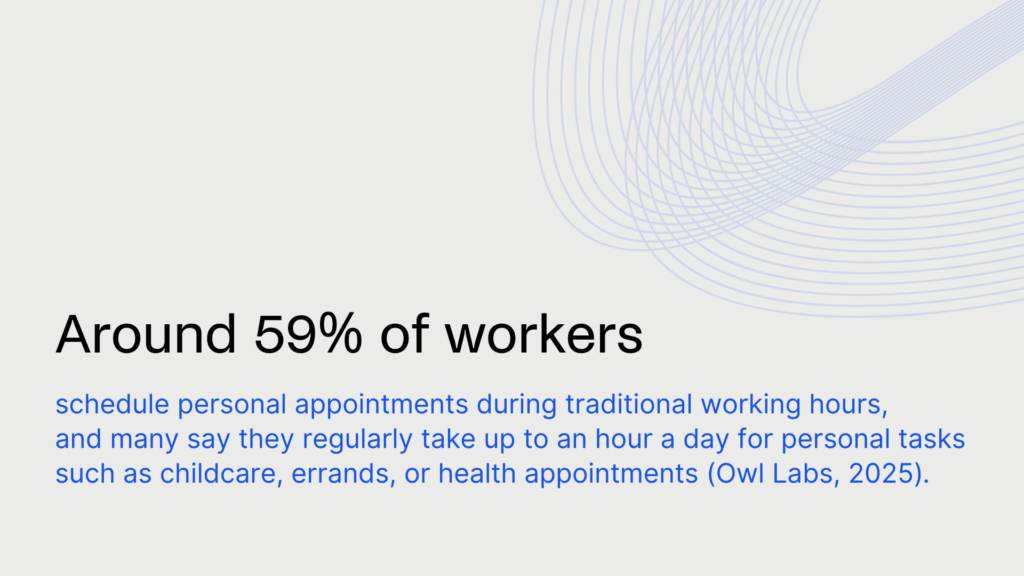
Owl Labs reports that around 59% of workers schedule personal appointments during traditional working hours, and many say they regularly take up to an hour a day for personal tasks such as childcare, errands, or health appointments.
They also highlight a trend they call “microshifting”. This is where people break their work day into short, non-linear blocks that fit around life: a deep-work block early in the morning, time off for school drop-offs, another block late morning, a break in the afternoon, then a final block later in the day. In the same report, about 65% of workers say they are interested in microshifting, and interest is especially high among managers and caregivers who are juggling more responsibilities.
Boundaries around meetings are changing, too. Most employees report that 8:00 a.m. is too early for meetings and 4:00 p.m. is too late, suggesting they prefer flexible hours rather than ones that extend into the early morning and evening.
All of this sits alongside familiar habits such as calendar blocking, no-meeting windows, and split shifts. The “future of flexible work” is not just a question of remote versus office. It is about smarter timing, clearer boundaries, and more honest conversations about when people can realistically do their best work.
Retention: How strongly does flexibility affect staying or leaving?
If there’s one big takeaway from the research, it’s this: flexibility is now a retention lever, not just a “nice to have” HR perk. For a lot of people, being able to work from home at least some of the time is directly tied to whether they stay or start looking elsewhere.
How many people would leave if WFH disappeared?
Pew Research Center’s survey gives one of the clearest signals. They looked at U.S. employees who have jobs that can be done from home and who currently work from home at least some of the time (excluding the self-employed). In that group, 46% say they would be unlikely to stay in their job if they could no longer work from home. Inside that 46%, 26% say they would be very unlikely to stay. Only 36% say they would be likely to stay, and 17% sit in the middle, saying they’d be neither likely nor unlikely to stay.
Some groups feel this even more strongly than others. Pew finds that fully remote workers are the most likely to walk: about 61% of people who currently work from home all the time say they would be unlikely to stay if that option was removed, compared with 47% of those who work from home most of the time and 28% of those who only do so some of the time. Women are slightly more likely than men to say they would not stay (about 49% vs 43%), and younger workers are more likely than older ones (around 50% of under-50s vs 35% of those 50 and over). People who are already less satisfied with their job are also much more likely to say they’d go if they lost WFH.
Owl Labs’ State of Hybrid Work 2025 report shows a very similar pattern when they ask hybrid and remote workers what would happen if their flexibility was taken away. If they could no longer work remotely or in a hybrid way, around 40% say they would start looking for another job, 22% say they would expect a pay rise to make up for the lost flexibility, 19% would stay but be less happy, and about 5% say they would flat-out quit. A much smaller share say they wouldn’t mind the change.
Flexibility as a stay factor
In the UK, the CIPD’s 2025 research goes a step further and looks at people who have already left their jobs. They find that about 3% of employees say they have left a job in the last year, mainly because it did not offer flexible working. At the national level, approximately 1.1 million workers in the UK alone changed jobs due to a lack of flexibility. The effect is even stronger for younger workers: the share is higher among 18–34-year-olds than in the workforce overall.
None of this means everyone will hand in their notice the moment you tighten your hybrid rules. But it does show that rigid, one-size-fits-all policies now carry a real cost in churn, especially among younger employees, women, and people who are already fully remote. In a tight talent market, that is a risk most organizations can’t afford to ignore.
Performance: How does flexibility affect productivity and well-being?
A lot of arguments about flexible work still come back to one big question: Does it hurt employee productivity or help it? The data is more balanced than the loudest headlines. Overall, it suggests that flexible work often helps or at least doesn’t harm productivity, but it really depends on how it is set up.
Productivity vs flexible working statistics
From the employee side, many people say they work better when they can match the task to the place.
In Owl Labs’ 2025 State of Hybrid Work report, workers say they feel more productive at home or in “third spaces” like coworking spaces for things like deep focus, independent work, and creative thinking. The office, on the other hand, remains useful for collaboration, team meetings, and relationship-building. This mix is one of the reasons so many people say hybrid is their ideal model.
On the employer side, the CIPD’s 2025 UK survey asked organizations what impact more home and hybrid working has had on performance. About 41% of employers report that productivity and efficiency have improved, 16% report that they have declined, and approximately 43% report that they have made little difference either way.
So the general picture is positive, but not magical. Flexible work is not a silver bullet, and it is not automatically a problem either. It tends to support productivity when roles, flexible workspace tools, and expectations are designed well. When those things are unclear, it can feel messy no matter where people work.
Statistics on flexible working and employee engagement
Productivity is only part of the story. How people feel about their work also matters.
Gallup’s global data shows that employee engagement and well-being are not just about being in the office or at home, but flexibility does make a difference. In their recent numbers, around 31% of fully remote workers are classed as “engaged”, compared with about 23% of hybrid workers and 23% of on-site workers in remote-capable jobs.
When you look at life evaluation, or how many people say they are “thriving,” the picture shifts a little. Roughly 42% of hybrid workers and on-site remote-capable workers say they are thriving, about 36% of fully remote workers say the same, and the lowest share, around 30%, is among workers in jobs that can never be done remotely at all.
Taken together, this suggests that having some choice and feeling like your work pattern fits your life is more important than following one “perfect” model. Many people do well working fully remote, many do well in hybrid setups, and some are happy on-site as long as the job and the support around it make sense.
Business performance
Zooming out to the company level, the question becomes: what does flexible work mean for growth?
A joint analysis by BCG and Flex Index looked at several hundred public companies and compared two groups: firms with fully flexible policies (for example, remote-first or employee choice) and firms with more mandate-driven policies (for example, structured hybrid with fixed office days or full-time office). Over the period from 2019 to 2024, they found that fully flexible companies grew revenue at about 12% per year on average, while mandate-driven firms grew at roughly 7% per year.
Even after controlling for size and industry, the flexible group still grew about 1.3 times faster than comparable firms with stricter office rules. That does not prove that flexible work causes better financial performance, but it does challenge the idea that flexibility is something only weaker or struggling companies offer. In reality, many of the best-performing companies are also the most flexible.
In short, the evidence so far does not support the fear that flexible working “kills productivity.” For many organizations, it either helps or has little negative impact; at the top end of the market, some of the fastest-growing firms are those that give people the most freedom in how and where they work.
Trends: How flexible work is evolving
Flexible work in 2025 looks quite different from the emergency setups of 2020. Policies are more structured, expectations are higher, and the focus is slowly shifting from “where you work” to “when and how you work.” A few big shifts stand out:
Hybrid “creep” and RTO pressure
Across the US and UK, hybrid work is still very common, but the rules around office time are getting tighter.
Flex Index data shows that more and more companies are moving to structured hybrid policies. The most popular pattern is now 2–3 days a week in the office, with three days becoming the default in many large firms. A Flex Index breakdown of Fortune 100 companies, for example, suggests that around two-thirds follow some kind of hybrid policy, and the single most common rule is “three days in the office,” with a smaller share pushing to four days and just under a third still requiring full-time in-office work.
In the UK, the CIPD’s 2025 survey finds that about 65% of organizations that allow hybrid working now set a minimum number of days in the workplace each week or month. For those with a weekly rule, three days is the most common requirement, followed by two days, with four-day patterns used by a smaller minority.
The same report notes that around 14% of UK employers who allow a hybrid work plan to introduce or increase mandatory office days over the next 12 months, which confirms that “RTO pressure” is still building rather than fading.
On the employee side, Pew’s survey shows that among US workers with remote-capable jobs who are not fully remote, roughly 75% now say their employer requires them to be on site a certain number of days each week or month, up from about 63% in early 2023.
Unequal access
While flexible work is spreading, access to it is still uneven.
First, there are big gaps by job type. Robert Half’s labor market analysis shows that hybrid and remote roles are far more common in high-skill, desk-based fields like technology, finance, marketing, consulting, and professional services. By contrast, many healthcare roles, administrative and customer support jobs, and hands-on operational roles are still advertised mainly as fully on-site. Even in fields like nursing, where there are now many online nursing programs for theory and coursework, the work itself still depends on in-person clinical placements and hands-on training.
Second, there are differences by country and region. For example, hybrid and remote work are much more common in Northern and Western Europe than in Southern and Eastern Europe, and cities still lead the way because they host more knowledge-intensive jobs and better digital infrastructure. Flex Index and other sources highlight that large metro areas and some states with strong knowledge economies have higher shares of hybrid roles than more rural or manufacturing-heavy regions.
Third, there are gaps by seniority. The CIPD reports that in the UK, many employees perceive flexible working to be easier to access for senior or professional staff than for junior staff or frontline workers, even inside the same organizations.
All of this adds up to a “flexibility divide.” The main benefits of flexible working, such as better work-life balance, reduced commuting time and cost, and more control over the workday, are still concentrated in certain sectors, locations, and job levels.
The future: What does this all mean for employers
Pulling it together, a few clear lessons show up across the research:
1️⃣ Treat flexibility as strategic, not cosmetic.
Flexible working now affects whether people join you, stay with you, and how positively they talk about your company. It also shows up in the data on revenue growth and performance, so it belongs in the same conversation as salary bands, benefits, and headcount planning. Return-to-office decisions are no longer just “HR housekeeping”; they are big business choices.
2️⃣ Design for hybrid, not just “remote vs office”.
Most remote-capable workers say their ideal setup is hybrid, with some time at home and some time in the office. That means you need a clear view of which activities genuinely benefit from being in person and which can be done anywhere. A blanket “three days in” rule is a start, but the real value comes from designing days around collaboration, focus time, and customer needs, not just filling desks.
3️⃣ Remember that “when” matters as much as “where”.
People don’t just want freedom over location – they also care about when they work. Microshifting, sensible meeting windows, compressed weeks, and part-time options all help employees fit work around childcare, commutes, health, and energy levels. A strict 9–5 in the office, plus a long commute on top, will feel out of touch for many roles that could be organised more flexibly.
4️⃣ Measure outcomes, not presence.
The organizations that thrive with flexible work usually focus on outputs: quality of work, customer satisfaction, project delivery, and well-being. If you rely mainly on badge data, webcam checks, or keyboard monitoring, you’ll get a very narrow (and often misleading) view of performance. Shifting to outcome-based measures also gives managers a clearer way to manage hybrid and remote teams fairly.
5️⃣ Watch the equity gap.
Right now, flexibility is still easier to get if you are office-based, higher paid, or in certain regions and roles. Frontline, lower-paid, and rural workers often have far fewer options, even when some flexibility in hours or shifts would be possible. Building role-appropriate flexibility for these groups – smarter schedules, shift swaps, compressed weeks, predictable schedules – is both a fairness issue and a competitive advantage.
6️⃣ Co-create policies with teams.
Research suggests that teams that help shape their own hybrid norms are more likely to see the policy as fair and good for workplace collaboration. Leaders can set the overall guardrails (for example, minimum coverage, core hours, office capacity), then invite teams to agree on how they work within those boundaries. This bottom-up element can turn hybrid rules from something people resist into something they feel they own.
The main message from the 2025 data is simple: flexible working is not a temporary pandemic fix. It is a long-term reshaping of how, where, and when work gets done. Organizations that accept this and design flexible, fair, clear policies are better placed to keep their people, attract new talent, and perform well.
Summary of the latest flexible working statistics
🏢 Flexible working adoption statistics
- Among U.S. adults whose jobs can be done from home, about 75% are working from home at least some of the time.
- For remote-capable employees (Gallup), the split is roughly half working hybrid, about three in ten fully remote, and roughly one in five fully on-site.
- In the UK, 91% of organizations offer at least one kind of flexible working arrangement.
- Around 88% of employers offer some form of home or hybrid working.
- 58% of employers say all or most employees in their organization can work flexibly in some way.
- That leaves about two in five organizations where only some or a few employees have flexible options.
- Around 28% of organizations offer some kind of four-day work week (usually as compressed hours).
- In the Flex Index Q3 2025 data, around two-thirds of firms have some kind of work-location flexibility in their policies, and roughly one-third still expect employees to be fully in the office.
- In Robert Half’s Q3 2025 job ads data, about 24% of new roles were hybrid, 12% were fully remote, and 64% were fully on-site.
- In 2023 data, fully in-office postings were in the “high 60s to low 80s” percent range of new roles, with hybrid in the mid-teens and remote in the low teens.
- By 2025, this had shifted to roughly one in three new jobs, including some remote work (hybrid or fully remote).
👔 Statistics on flexible working preferences
- Among U.S. employees in jobs that can be done remotely, about six in ten say their ideal setup is hybrid.
- Around one-third would prefer to be fully remote.
- Less than one in ten would choose to be fully on-site.
- Among job seekers, roughly half say hybrid is their top choice.
- About a quarter say they would rather be fully remote.
- Only 19% say a fully in-office job is their first choice.
- In Owl Labs’ survey of hybrid workers, around 72% say they would choose hybrid again if they could.
- About 24% say they would rather be fully remote.
- Among workers who rarely or never work from home today, about 63% say that if they could choose, they would like to work from home most or some of the time.
💡 Flexible work importance
- In Owl Labs’ 2025 U.S. survey:
- 91% say compensation is very important.
- 89% say having a supportive manager is very important.
- 89% say benefits matter.
- 83% say being able to work flexible hours is important.
- 82% say flexible days are important.
- 79% say being able to work flexibly in terms of location is important.
- On average, workers say they would give up:
- Around 9% of their salary for flexible hours.
- About 8% for a four-day week.
- About 8% for a flexible working location.
- About 8% for more or unlimited vacation.
🪨 Retention vs flexible work
- Among U.S. employees who can work from home and currently do so at least sometimes:
- 46% say they would be unlikely to stay in their job if they could no longer work from home.
- Within that, 26% say they would be very unlikely to stay.
- 36% say they would be likely to stay.
- 17% say they’d be neither likely nor unlikely to stay.
- By group, the share who’d be unlikely to stay if WFH ended is:
- 61% of those who currently work from home all the time.
- 47% of those who work from home most of the time.
- 28% of those who work from home some of the time.
- 49% of women vs 43% of men.
- Around 50% of workers under 50 vs 35% of workers aged 50 and over.
- If hybrid/remote options were removed (Owl Labs):
- Around 40% would start looking for another job.
22% would expect a pay rise to make up for lost flexibility.
19% would stay but be less happy. - About 5% would flat-out quit.
- Around 40% would start looking for another job.
- In the UK (CIPD 2025):
- About 3% of employees say they have left a job in the last year mainly because it did not offer flexible working.
- This equates to approximately 1.1 million workers in the UK who changed jobs due to lack of flexibility.
- The share is higher among 18–34-year-olds than in the workforce overall.
🕙 Time, microshifting, and boundaries
- Around 59% of workers schedule personal appointments during traditional working hours.
- Many say they regularly take up to an hour a day for personal tasks.
- About 65% of workers say they are interested in microshifting (short, non-linear blocks of work).
- Most employees report that 8:00 a.m. is too early for meetings and 4:00 p.m. is too late.
💻 Productivity, engagement, and well-being
- In the CIPD’s 2025 UK employer survey on home/hybrid working:
- About 41% of employers say productivity and efficiency have improved.
- 16% say productivity has declined.
- Approximately 43% say it has made little difference.
- In Gallup’s global data:
- Around 31% of fully remote workers are classed as “engaged”.
- About 23% of hybrid workers are engaged.
- About 23% of on-site workers in remote-capable jobs are engaged.
- On life evaluation (“thriving”):
- Roughly 42% of hybrid workers and on-site remote-capable workers say they are thriving.
- About 36% of fully remote workers say they are thriving.
- Around 30% of workers in jobs that can never be done remotely say they are thriving.
- In the BCG + Flex Index analysis of several hundred public companies, 2019–2024:
- Firms with fully flexible policies grew revenue at about 12% per year on average.
- Mandate-driven firms grew at roughly 7% per year.
- After controlling for size and industry, the flexible group still grew about 1.3 times faster than comparable firms with stricter office rules.
📈 Trends and RTO pressure
- The most popular structured hybrid pattern is now 2–3 days a week in the office, with three days becoming the default in many large firms.
- In a Flex Index breakdown of Fortune 100 companies:
- Around two-thirds follow some kind of hybrid policy.
- The single most common rule is “three days in the office.”
- A smaller share use four days in the office.
- Just under a third still require full-time in-office work.
- In the UK, among organizations that allow hybrid working:
- About 65% now set a minimum number of days in the workplace each week or month.
- With a weekly rule, three days is the most common requirement, followed by two days, with four-day patterns used by a smaller minority.
- Around 14% of these employers plan to introduce or increase mandatory office days over the next 12 months.
- On the employee side in the U.S., among workers with remote-capable jobs who are not fully remote:
- Roughly 75% say their employer requires them to be on site a certain number of days each week or month.
- This is up from about 63% in early 2023.
Sources
- Owl Labs, State of Hybrid Work 2025.
- Robert Half. Remote Work Statistics and Trends for 2025.
- Flex Index, The Flex Report Q3 2025.
- Gallup, Hybrid Work Indicator.
- Pew Research Center, Many remote workers say they’d be likely to leave their job if they could no longer work from home.
- CIPD, Flexible and hybrid working practices in 2025.

Berenika Teter
Archie's Content Manager, fueled by filter coffee and a love for remote work. When she’s not writing about coworking spaces and hybrid workplaces, you can probably find her exploring one.