
















- What you’ll learn
- The most important coworking industry statistics
- How fast the global coworking market is growing
- Which trends are shaping the future of coworking
- What these numbers mean for coworking operators
Trying to stay updated on coworking industry stats? Smart move. Knowing how coworking spaces are evolving can help you see where your coworking business stands.
The challenge? There’s a lot of information out there. A quick Google search for “coworking statistics” pulls up over 6 million results in less than a second. Sounds helpful, but…
Here’s the problem: A lot of the data floating around is outdated. Some reports still use numbers from five years ago! Given how much the coworking industry has changed in the last few years, relying on old data can give you the wrong picture of where the industry is headed and how you should adapt.
Instead of sorting through endless reports, we’ve gathered the most important coworking stats and trends so you don’t have to. Let’s explore what they mean for your coworking business.
Key coworking industry statistics
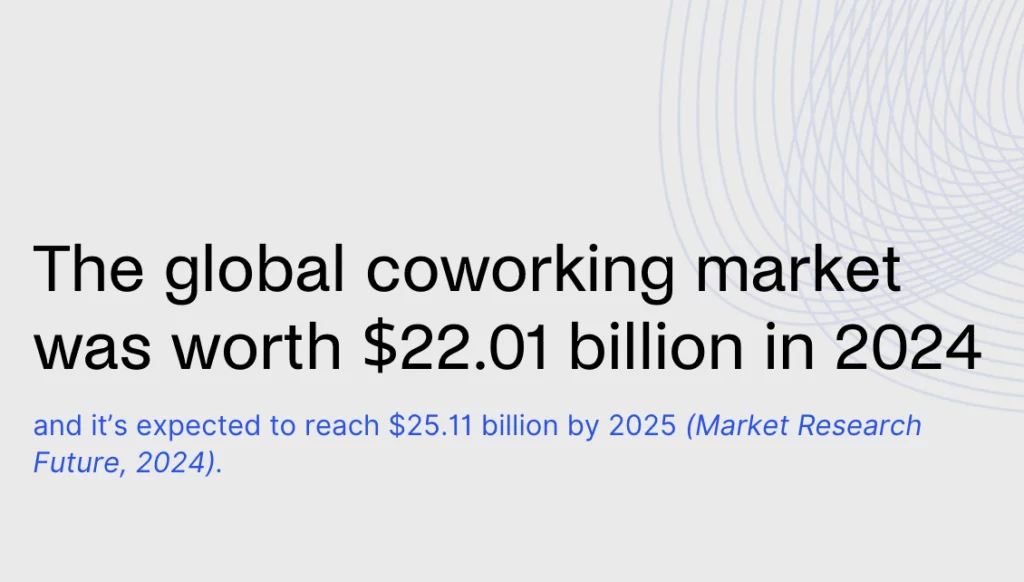
- The global coworking spaces market was valued at $22.01 billion in 2024 and Market Research Future projects it could reach $93.68 billion by 2035, growing at about 14.07% CAGR (2025 to 2035).
- CoworkingCafe’s U.S. Coworking Industry Report (Q2 2026) puts the national median starting price at $219 per month for memberships (open workspace plus dedicated desk) and $34 for a day pass.
- The same report found that coworking accounted for 2.34% of the U.S. commercial real-estate market in 2026.
- CoworkingCafe reports that the US reached 9,384 coworking locations covering roughly 166 million square feet in Q2 2026.
- On the operator scale, CoworkingCafe notes that Regus is the largest US operator, with roughly 1,185 locations nationwide (and 950 across the top 50 markets).
- Deskmag’s 2025 survey reporting suggests profitability improved compared with earlier years: 54% of coworking businesses were profitable, and 18% reported losses over the previous 12 months.
The current state of the coworking industry — statistics
Coworking is one of the fastest-growing parts of the office world right now. The global coworking and flexible office market is currently worth around $21 billion, and it’s expected to nearly triple by the early 2030s. In fact, coworking experts predict it will grow to an incredible $82.12 billion by 2034, with a strong yearly growth rate of 14.1%. Other studies estimate the market will be worth $51.42 billion in 2029 and $40.47 billion by 2030 (growing at 15.7% per year).
Even with economic ups and downs, demand for coworking is still strong around the globe. By the end of 2024, there were about 42,000 coworking spaces worldwide, and the number kept climbing in 2025.
What’s exciting is that coworking still makes up only a small slice of all office space globally. That means there’s a lot more room to grow in the years ahead as more people and businesses choose flexibility over traditional office leases.
Why are coworking spaces growing?
Several key factors drive the rise of coworking spaces:
- More freelancers and startups: The number of independent workers is growing worldwide. Many freelancers and startups prefer coworking spaces because they offer affordable, flexible office solutions without long-term contracts.
- Hybrid and remote work boom: Since COVID-19, many companies have adopted hybrid work models, allowing employees to split their time between home and the office. Businesses are turning to coworking spaces instead of leasing traditional office spaces for flexibility, cost savings, and access to high-quality work environments.
- Big companies are joining in: It’s not just startups — large corporations are also using coworking spaces for their remote teams, satellite offices, and short-term projects.
- Cost savings: Renting an office is expensive, especially in big cities. Coworking spaces provide a cheaper alternative with different amenities like WiFi, meeting rooms, and printing services.
- Government support: Some governments encourage coworking spaces as a way to support entrepreneurs and small businesses.
- Technology upgrades: Many coworking spaces are investing in smart technology, including coworking management tools, automated access control, and visitor tracking systems, which automate daily operations and help run spaces efficiently.
Stats on key players in the coworking industry
The coworking industry is dominated by the largest coworking brands, each offering unique office solutions. Globally, some of the biggest coworking providers include:
- WeWork – One of the most well-known coworking brands worldwide.
- International Workplace Group (IWG) – Parent company of Regus and Spaces.
- Impact Hub – Focuses on social impact and innovation.
- The Executive Centre – Premium coworking spaces for professionals.
- Newmark – A growing competitor in flexible office spaces.
- Techspace Group Ltd. – Provides coworking solutions for tech companies.
Regus, owned by International Workplace Group (IWG), remains the largest coworking operator, with 1,018 locations in the US. IWG reported 11% year-over-year growth in system-wide revenue to $2.4 billion in H1 2026, with its network spanning more than 120 countries.
Other fast-growing coworking brands include Industrious, which grew by 13% in top US markets, and Spaces, which expanded by 10% in the last quarter of 2024.
While some brands are expanding, others are facing challenges. WeWork, once a major coworking leader, saw a slight decline (3%) but still operates 148 locations in the US. The coworking market is competitive, and brands must continue innovating to stay ahead.
What are the demographics of coworking spaces?
While there hasn’t been a ton of new data recently, some key trends still hold true. The average coworking member is around 36 years old, and Millennials (those aged roughly 28 to 43) make up the majority, about 61%. Women now make up nearly half of coworking users, with their share steadily growing over time. On the education side, around 80% of members have a college degree, though that number is slowly going down as coworking becomes more inclusive and draws in younger workers, creatives, and professionals from all walks of life.
Who’s using coworking spaces, and why?
Coworking spaces attract a diverse mix of professionals, including:
- Freelancers – Independent workers who need a professional workspace without high costs.
- Startups & small businesses – New companies that need an affordable, flexible office and networking opportunities.
- Corporations – Large companies using coworking spaces for remote teams, client meetings, and temporary offices.
- Remote workers – Employees looking for a workspace that offers more structure and fewer distractions than working from home.
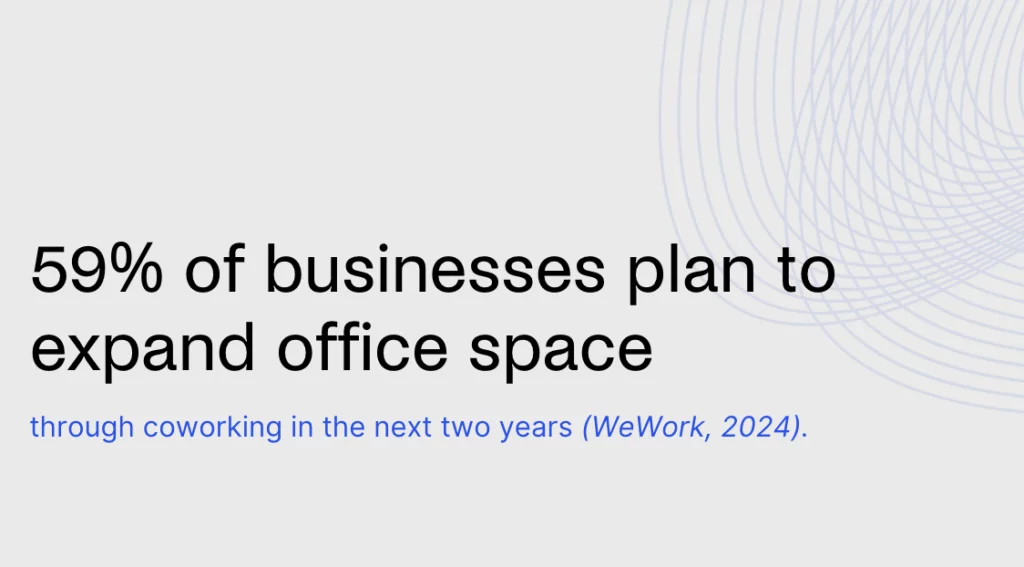
The numbers back this up. Corporate teams make up 27.6% of the coworking market, and the trend is growing. A recent WeWork survey found that most companies, regardless of their work model, plan to expand office space in the next two years, and nearly 60% prefer coworking spaces over traditional leases. Why? Because businesses are rethinking how they work, and coworking offers the flexibility, cost savings, and speed they need.
Enterprise coworking is becoming mainstream
With economic uncertainty and rising operating costs, many companies are rethinking how they grow. Instead of signing long office leases, they’re looking for workspace options that are more flexible, easier to scale, and less risky.
That’s where coworking fits in.
For many businesses, coworking is no longer just a short-term fix or a place for freelancers. It is becoming part of a bigger workplace strategy. Companies are using flexible workspaces for satellite offices, distributed teams, project-based work, and employee work hubs closer to home.
Recent research from JLL describes this as the rise of the “elastic portfolio,” where companies mix traditional office space with flexible workspaces to reduce risk and adapt faster to changing team needs. JLL also notes that only 3% of large companies currently use flexible space for more than 10% of their office portfolio, which suggests there is still a lot of room for growth.
CBRE’s 2026 workplace research points in the same direction. It found that hybrid work is pushing companies to optimize their office space, reduce wasted space, and make the office more useful for collaboration. CBRE also reported that global average building utilization reached 53%, up from 38% in 2024 and 35% in 2023, showing that companies are bringing people back in, but not in the same way as before.
This is changing what coworking spaces need to offer. To attract larger teams, many operators are adding more:
- Private offices and team suites
- Meeting rooms and video conferencing setups
- Security and access control
- Flexible contracts for short-term or project-based teams
- Amenities for hybrid employees who visit only a few days a week
Coworking is also becoming a workplace benefit. Instead of paying for one large office that employees may not use every day, companies can offer coworking memberships that let people work closer to home while still having access to a professional workspace.
But coworking isn’t just for businesses. The number of independent workers using coworking spaces is expected to grow significantly from 2024 to 2030. Many freelancers find it hard to work from home due to distractions or isolation, so coworking spaces offer a productive environment with social interaction and networking opportunities. Speaking of…
The social side of coworking
Coworking spaces offer more than just a place to work; they create an environment that improves productivity while fostering social connections. Many feature amenities like yoga rooms, meditation areas, and quiet zones for breaks, promoting a healthier work-life balance. Some even provide childcare and wellness programs.
However, coworking spaces aren’t always equally accessible. Some high-end locations for coworking spaces come with expensive memberships, making them available only to certain groups. This has raised concerns about coworking spaces contributing to gentrification, as they often replace traditional offices and cater to wealthier professionals.
That said, the best coworking spaces can also bring people from different industries and backgrounds together. Many workers build strong friendships and business connections in these spaces, while others simply enjoy the flexibility of working around others without too much interaction.
Coworking is moving closer to where people live
For years, coworking spaces were mostly found in busy downtown business districts. But that’s starting to change.
One of the biggest coworking trends right now is the rise of suburban coworking spaces, neighborhood work hubs, and smaller satellite offices closer to where people live.
This shift is closely tied to hybrid work. Many employees no longer want to commute into the city five days a week, but they also don’t want to work from home all the time. They want a third option: a professional workspace nearby that is easy to access a few days a week.
That’s why more coworking operators are expanding beyond traditional city centers and opening locations in residential neighborhoods, suburbs, and smaller cities.
This “closer-to-home” model offers a few clear benefits:
- Shorter commutes for hybrid workers
- Lower real estate costs than downtown office towers
- Better work-life balance for employees
- Easier access to workspace outside major cities
- More chances to build local business communities
This also fits with the rise of distributed workplace strategies. Instead of relying only on one large headquarters, companies are using a mix of central offices, regional work hubs, and coworking spaces closer to employees.
As a result, the coworking model is changing too. In many suburban locations, the focus is less on large open desk areas and more on private offices, meeting rooms, quiet spaces, and practical amenities for people who need a productive place to work near home.
Regional coworking statistics and market trends
Coworking spaces are expanding rapidly worldwide, driven by the rise of remote and hybrid work models. The coworking industry is particularly strong in North America, Europe, and Asia-Pacific, with notable growth in emerging markets across Latin America, the Middle East, and Africa. Each region has its unique trends, pricing, and challenges, shaping the coworking industry in different ways.
North America: The largest and most developed market
North America is still one of the biggest coworking markets in the world, with the US leading the way. But the latest data shows that coworking growth is starting to look a little different.
For a long time, the biggest coworking stories came from major cities like Manhattan, San Francisco, Los Angeles, and Washington, D.C. Now, growth is spreading into more mid-sized and secondary markets, too.
According to CoworkingCafe, by the end of Q1 2026, the US had 9,136 active coworking locations, up from 8,854 at the end of 2025. That means the market added 282 coworking spaces in just one quarter. Total coworking space also grew from 159.4 million to 163.9 million square feet.
Even with this growth, coworking still makes up only 2.28% of total US office space. So while the market is already large, there is still a lot of room for it to grow.
One interesting detail is that the number of locations grew slightly faster than the total amount of space. This suggests that more operators are opening smaller coworking spaces, not just large downtown hubs. The average US coworking location is now about 17,945 square feet, slightly down from the previous quarter.
This fits with a bigger trend: coworking is moving closer to where people live. Hybrid workers do not always want to commute into a city center just to work for a few hours or a couple of days per week. As a result, operators are opening more suburban locations, neighborhood hubs, and smaller satellite spaces.
Some of the strongest growth in Q1 2026 came from markets outside the usual top-tier cities, but large cities still matter, of course. Los Angeles had the most coworking locations in Q1 2026, with 351 spaces. Dallas-Fort Worth followed with 337, Chicago had 336, Washington, D.C. had 311, and Manhattan had 308.
Pricing stayed fairly stable at the national level. The median coworking membership was $220 per month, meeting rooms stayed at $45 per hour, day passes increased slightly from $30 to $33, and virtual offices rose from $159 to $169 per month.
Operator growth is also becoming more interesting. Regus is still the largest coworking operator in the US, with 1,237 locations nationwide. HQ and Industrious both grew quickly among the largest brands, each increasing their footprint by 4.5% in Q1 2026.
Still, the US coworking market is not controlled only by big brands. The five largest coworking operators control about 23% of all US coworking locations, while the remaining 77% is run by thousands of independent, regional, and boutique operators.
Overall, the US coworking market looks healthy, but more mature than before. Growth is no longer just about opening huge spaces in the biggest cities. It is now about finding the right markets, choosing the right space formats, and creating flexible workspaces that fit how people actually work today.
Europe: Strong demand and steady expansion
Coworking continues to grow steadily across Europe, but the market is becoming much more mature and diverse than it was a few years ago.
According to Mordor Intelligence, the European coworking market is expected to grow from about $12.93 billion in 2026 to $18.2 billion by 2031, with a projected annual growth rate of 7.13%.
One of the biggest drivers behind that growth is enterprise demand. Mordor Intelligence reports that enterprises already account for more than 42% of the European coworking market, showing just how mainstream flexible office space has become for larger companies.
The UK and Germany remain two of Europe’s largest coworking markets, but growth is also accelerating in countries like Spain, Portugal, and Poland.
According to the latest data from CoworkingCafe, the UK and Ireland alone reached 4,698 coworking locations in Q2 2026. The UK accounted for 4,415 spaces, while Ireland added another 283. London continues to dominate the UK market with 1,275 coworking spaces, making it one of the largest flexible workspace hubs in the world.
Pricing across Europe varies heavily by city. In the UK, the median monthly coworking membership is around £180, while Greater London averages about £210. Oxford is currently the most expensive UK market at roughly £244 per month.
In Germany, coworking is also gaining ground. Large spaces (over 500 sqm) are doing particularly well, with about 75% occupancy. However, small spaces are still struggling to stay full. While event and meeting rooms are in high demand again, profitability remains a challenge. Only 20% of coworking spaces in Germany were profitable in 2023, while 42% just covered their costs. The main challenges include high rent and energy costs, which are particularly hard for small coworking spaces that fear losing members if they raise prices.
Spain’s flexible-workspace sector expects 15.8% revenue growth in 2026. Private offices represented 54% of total flexible-workspace area in Spain and generated 75% of revenue among large operators.
One major trend across Europe is the rise of smaller and medium-sized coworking spaces. Mordor Intelligence found that medium-sized hubs currently generate the largest share of coworking revenue, while smaller neighborhood-focused spaces are expected to grow the fastest through 2031.
Asia-Pacific: The fastest-growing market
The Asia-Pacific region is quickly becoming the hottest spot for coworking growth. Countries like India, China, Japan, and Australia are leading the way, thanks to the rising demand for flexible workspaces and the ongoing shift to hybrid work.
India is especially exciting right now, as it’s turning into a major coworking hub, with strong government support for startups and small businesses. China and Japan already have well-developed coworking scenes in big cities like Shanghai, Beijing, Tokyo, and Osaka. Australia is also growing steadily, with Sydney and Melbourne at the center of the action.
By 2030, the Asia-Pacific coworking market is expected to reach $11.82 billion, growing at a fast pace of around 21% per year. That’s much faster than the global average, showing just how strong demand is in this part of the world. While North America is still the largest coworking market overall, Asia-Pacific is catching up quickly thanks to its rapid expansion and growing appetite for flexible office solutions.
Latin America: Steady growth and increased adoption
Latin America’s coworking industry is growing steadily, with Brazil leading the market. Mexico and Argentina are also seeing increased adoption of coworking, particularly among startups and small businesses looking for cost-effective office solutions.
Middle East and Africa: Emerging markets with growth potential
The Middle East and Africa are emerging coworking markets, with Dubai, Riyadh, and Johannesburg leading the way. Many coworking spaces in these regions focus on premium office setups for corporate clients and support local entrepreneurs and startups. In the Middle East and Africa, more than 90% of corporate real-estate portfolios remained committed to traditional long-term leases in October 2026. The United Arab Emirates (UAE) has seen significant coworking expansion thanks to government incentives for flexible workspaces.
Coworking space profitability
A global survey from Deskmag suggested that coworking spaces started 2025 in a fairly healthy place. Coworking operators said that most spaces gained more members than they lost. When membership went up, revenue usually went up too. Many operators also said profits improved. However, it was not positive for everyone, and about one in six operators said their profitability went down.
But one of the biggest shifts happening in coworking profitability is where revenue actually comes from. Operators are becoming much more strategic about which products and services generate the strongest margins, the most predictable recurring revenue, and the lowest operational overhead.
Profitability is higher in major cities
Profitability was much stronger in major cities. Over the last 12 months in the survey, 54% of coworking businesses were profitable, and 18% reported losses. Location made a big difference: in cities with more than 1 million residents, nearly two-thirds of spaces were profitable. In towns with fewer than 20,000 people, only about 1 in 5 operators reported a profit, although about half at least broke even. This helps explain why coworking can look like a strong business in big metros, while smaller towns can feel like a tougher environment.
Occupancy is rising, and meeting space is in demand
Occupancy and demand were also improving, especially for meeting space. Global average occupancy reached 68% at the start of 2025, and it was well above 70% in major cities. Meeting spaces were one of the most in-demand offerings worldwide, and about half of operators also reported strong demand for team offices and single-person offices. The mix changes by location too: in cities, team offices and meeting rooms are a strong combination, while in rural areas, demand for event space is often higher, and demand for team offices can be much weaker.
The shift toward private space is becoming even clearer in newer operator data. According to operators interviewed in the Undercurrents: The New Revenue Stack report, private offices now account for roughly 72.5% of average coworking revenue, while traditional coworking memberships represent only about 8.8%. On-demand products like meeting rooms, event spaces, and day passes account for another 7.2% of revenue.
This suggests that many coworking operators are moving away from relying mainly on hot desks and are instead focusing more on private offices, flexible team suites, meeting rooms, and event-driven revenue.
Coworking spaces are diversifying revenue beyond desks
Another major profitability trend is the rise of ancillary revenue streams. More coworking operators are trying to increase revenue per member without simply adding more desks or square footage.
Operators interviewed in the report described growing revenue from:
- Virtual mailboxes and business addresses
- Event spaces and workshops
- Meeting room memberships
- Concierge and catering services
- Podcast studios
- Printing and IT packages
- Storage and locker rentals
- Advertising networks
- Community memberships and virtual office add-ons
Several operators specifically highlighted virtual office services and mailboxes as surprisingly strong revenue drivers because they create recurring income without requiring much physical space. One operator even said that five virtual business centers generated revenue equal to one smaller physical coworking location.
Another operator reported generating roughly $4,000–$5,000 per center per month through digital advertising networks running on screens inside meeting rooms and shared spaces.
Space per desk is rising, and it changes what “good layout” means
Deskmag’s 2025 survey results suggest that a “typical” coworking space has around 90 desks and about 1,200 m² of space, but most spaces do not match that exact profile.
A helpful benchmark here is space per desk, which Deskmag calculates by dividing total area by the number of desks. The average is now about 14.4 m² per desk (155 ft²), and Deskmag says this is well above pre-pandemic levels. That does not mean every space is getting emptier. It often means the space is being used differently.
Many operators are redesigning spaces around:
- Private offices
- Meeting rooms
- Quiet zones
- Event space
- Flexible team areas
Instead of trying to maximize desk density alone.
Offerings matter more than desk density when it comes to profit
One of the most practical takeaways is that packing in desks is not a reliable path to profitability. Deskmag is pretty direct here: desk density on its own has little impact on profitability, and what matters more is the offering mix and the layout. They also note that the spaces that show up as frequently unprofitable are often the ones with extreme desk density, and these are typically very small coworking spaces.
Several operators in the Undercurrents: The New Revenue Stack report echoed the same idea. One operator admitted that early locations had far too many open-plan desks and later shifted heavily toward private offices because demand for dedicated desks had “completely evaporated” after COVID.
In other words, success is less about “how many desks can I fit” and more about “what do my members actually pay for here.” For many markets, that means balancing open desks with private offices, meeting rooms, event space, and scalable recurring services that increase revenue without increasing square footage.
Top challenges for the coworking industry
The coworking industry is booming, but it’s not without challenges:
1. Coworking profitability struggles
One of the biggest challenges for coworking spaces is turning a profit. While demand for flexible workspaces is increasing, many coworking spaces are barely breaking even or losing money. The Global Coworking Survey shows that nearly half of the surveyed coworking spaces struggle to turn a profit, with 18% reporting losses.
Several factors make it difficult for coworking spaces to be financially stable:
- High rent & operating costs: Commercial real estate prices continue to rise in major cities, making it expensive to rent and maintain coworking spaces.
- Energy & utility bills: Keeping the lights on, running high-speed internet, and maintaining common areas can be costly.
- Membership prices: Many coworking spaces hesitate to raise prices for fear of losing members, which limits their ability to cover expenses.
To survive, coworking spaces must find ways to increase revenue without pricing out their customers. This could mean offering additional services like private or virtual offices, event spaces, business support, and wellness programs.
💡 If that sounds like something you might be interested in, here’s our guide to increasing coworking profitability →
2. Competition is heating up
With more coworking spaces opening every year, competition is getting tougher. Big brands like WeWork, Regus, and IWG dominate the market, making it difficult for small, independent coworking spaces to attract members.
Corporate coworking chains have the advantage of scalability — they can offer consistent services, premium office locations, and competitive pricing that smaller spaces may struggle to match. Meanwhile, many landlords are converting vacant office spaces into coworking hubs, increasing competition even further.
To stay competitive, independent coworking spaces need to differentiate themselves by offering unique member experiences, such as:
- Industry-specific coworking (e.g., tech-focused, creative hubs, healthcare coworking spaces).
- Community-driven spaces with networking events, workshops, and mentorship programs.
- Wellness and lifestyle integration include yoga studios, meditation rooms, and on-site cafés.
3. Finding and retaining members
Coworking spaces rely on consistent membership numbers to stay profitable, but attracting and keeping members isn’t always easy. Word of mouth remains the most effective way to gain new members. However, many coworking spaces struggle with member retention, especially in areas with low population density or high competition.
Additionally, the rise of hybrid work models means that some professionals only use coworking spaces part-time, making it harder to predict revenue. Many coworking spaces now offer flexible membership plans (e.g., pay-per-day options, part-time passes, or bundled packages) to adapt to changing work habits.
4. Economic uncertainty and real estate challenges
The coworking industry is closely tied to economic conditions and real estate trends. Coworking spaces will struggle to keep costs low if office space rental prices increase. On the other hand, landlords might convert office buildings into coworking spaces if too many vacant commercial properties flood the market and make competition even tougher.
Additionally, economic downturns can affect businesses’ ability to pay for coworking memberships. Startups, small businesses, and freelancers, a big part of the coworking community, are often the first to cut expenses during financial struggles. This means coworking spaces must balance affordability while staying profitable.
The future of coworking: What’s next in 2026 and beyond
The future of coworking spaces is full of possibilities. Whether they become standardized corporate hubs or unique, community-driven workspaces, one thing is clear: Coworking is here to stay.
Standardization vs. specialization
As coworking spaces grow, experts predict two possible paths for the industry: homogenization or differentiation:
- If large coworking companies like WeWork, Regus, and IWG continue to dominate, coworking spaces may become more corporate and uniform. These spaces will focus on business clients, offering consistent coworking space designs, amenities, and services across locations. While this standardization could make coworking more accessible to big companies, it may reduce variety and flexibility for freelancers and smaller teams who prefer unique, community-driven spaces.
- On the other hand, coworking spaces might become more diverse and specialized, adapting to local needs, industries, and work styles. Independent coworking spaces could grow, offering customized environments for creatives, tech startups, or remote workers. There is a growing trend toward niche coworking spaces that cater to specific industries, such as Med-Tech or fashion, fostering collaboration and networking within specialized sectors.
Coworking spaces as the future of work
Instead of requiring employees to return to a central office, many businesses are choosing coworking spaces as flexible satellite offices. This shift is influencing hybrid work policies, with some companies offering coworking memberships as part of their benefits package.
At the same time, real estate trends will impact the coworking industry. As landlords struggle with vacant office buildings, they may convert traditional office spaces into coworking hubs. This could reduce coworking costs in some areas, making flexible workspaces more accessible. However, if real estate prices remain high, coworking spaces might struggle to stay affordable for freelancers and small businesses.
The use of coworking technology
A 2026 report from The Business Research Company estimates that the coworking management software market reached $2.21 billion in 2026 and could grow to $3.68 billion by 2030, with annual growth above 13%.
No wonder. These days, coworking technology is doing way more than just powering the Wi-Fi in shared spaces.
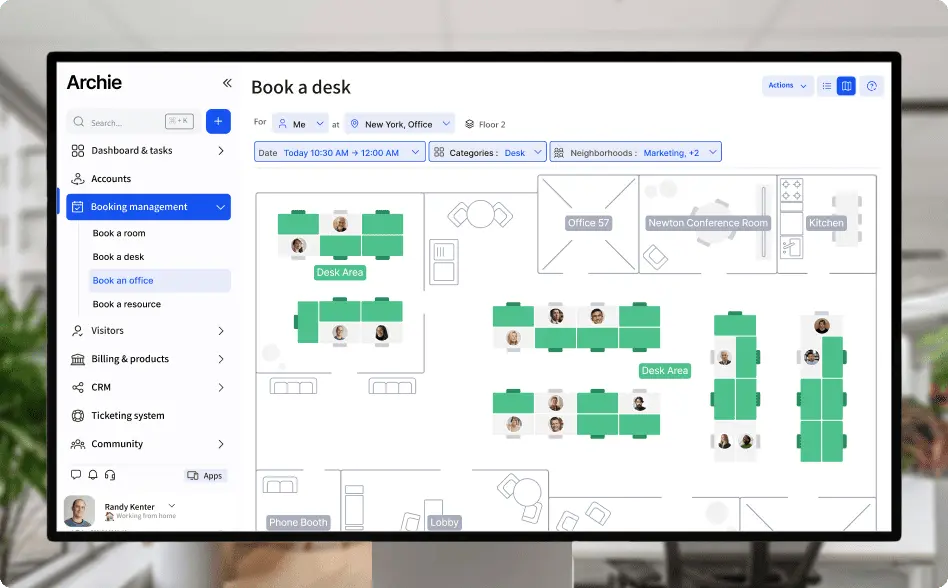
Coworking management software like Archie is helping teams automate things like invoicing, member onboarding, access control, and reporting. Some coworking spaces have saved over 15 hours a week, giving staff more time to focus on members instead of admin.
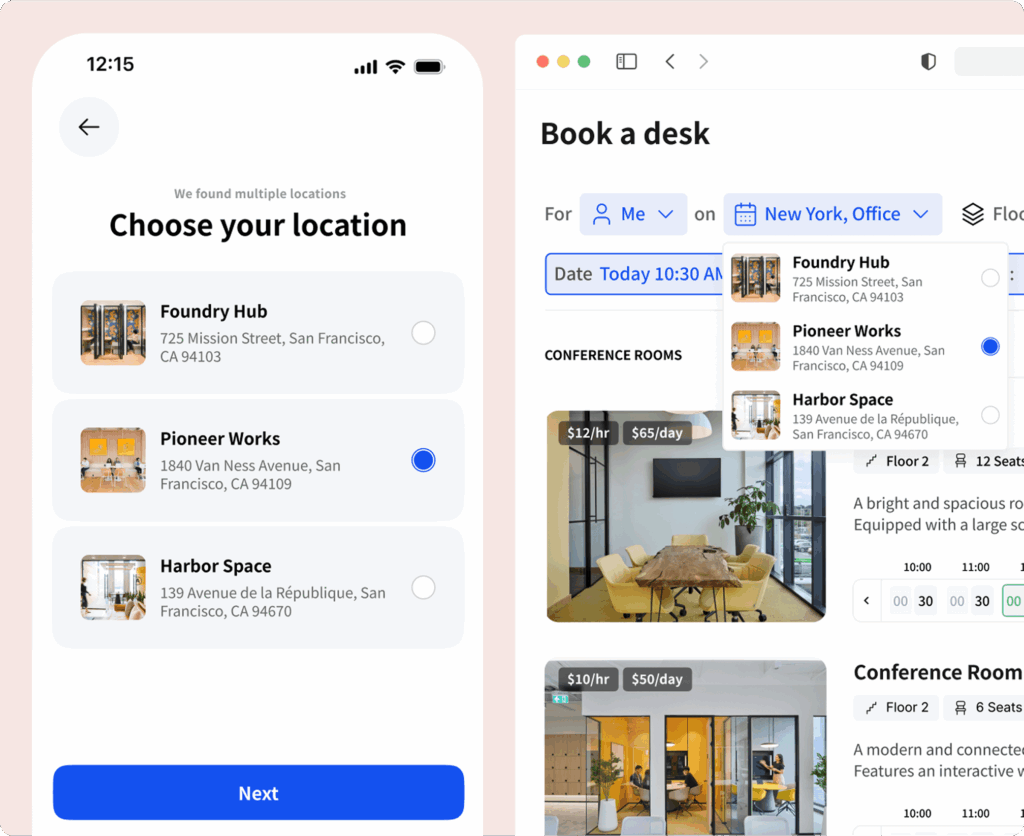
At the same time, many spaces use AI chatbots to answer questions, schedule tours, and even sell memberships, saving staff time and speeding up response times. AI also helps behind the scenes by studying how people use the space, which has multiple benefits:
Smarter pricing and personalization with AI
Operators are no longer guessing what members want or how much to charge. Instead, they’re using data and AI tools to understand how people actually use the space. This helps them offer more personalized memberships, recommend events people will genuinely enjoy, and even match members with mentors. It’s like giving each person their own tailor-made coworking experience.
One major game-changer is AI-powered pricing. Instead of using static price lists, operators can now adjust prices in real time based on demand. So, when certain desks or rooms are in high demand, prices go up slightly. When things are quieter, prices drop to attract more bookings. According to Flexspace AI, this dynamic pricing model has helped coworking operators boost revenue by over 50%, all without raising prices across the board.
The role of community in coworking spaces
Coworking spaces have always been seen as places for collaboration and networking, but not all spaces automatically create a strong sense of community. In many cases, community managers actively curate interactions, choosing which events, networking opportunities, and social activities to promote. This can be great for some workers but also exclude certain groups or reinforce social divisions.
The challenge for the future is ensuring coworking spaces remain inclusive and accessible to a diverse range of people. If prices continue to rise, coworking could become a luxury reserved for well-paid professionals, leaving out freelancers, early-stage startups, and lower-income workers who also need flexible work environments.
A summary of the most recent coworking statistics
Here are all the key coworking statistics mentioned in the article:
📊 Industry growth and market value
- In 2025, the global coworking and flexible office market is worth around $21 billion.
- Coworking experts predict the market will grow to $82.12 billion by 2034, at a 14.1% annual growth rate.
- Other estimates in the article put the market at $51.42 billion in 2029 and $40.47 billion by 2030, growing at 15.7% per year.
🏢 Number of coworking spaces and footprint
- By the end of 2024, there were about 42,000 coworking spaces worldwide.
- In the US snapshot referenced by Coworking, U.S. coworking inventory grew 2.7% in Q2 2026, reaching 9,384 locations nationwide.
- The US coworking inventory is described as just over 166 million square feet.
- Coworking is described as about 2.3% of total US office space.
- The average coworking location is described as around 18,000 square feet.
💸 Pricing benchmarks
- The US national median is described as $219/month for memberships.
- The US national median is described as $34 for day passes.
🧑💼 Coworking users and adoption
- Corporate teams make up 27.6% of the coworking market.
- A WeWork survey is described as finding that nearly 60% of companies prefer coworking over traditional leases when expanding office space (also shown as 59% in a caption-style line).
🧩 Industry breakdown
- Industries investing most in coworking are listed as: IT and tech (50%), financial services (50%), construction (43%), energy (43%), and business services (30%).
🧑🤝🧑 Coworking demographics
- The average coworking member is around 36 years old.
- Millennials are described as being roughly 27 to 42 years old.
- Millennials are said to make up about 61% of members.
- Women are said to make up nearly half of coworking users.
- Around 80% of members are said to have a college degree.
🌍 Regional market snapshots
- By Q1 2026, the US coworking market reached 9,136 active coworking locations nationwide, up from 8,854 at the end of 2025.
- Total US coworking inventory reached 163.9 million square feet in Q1 2026.
- Coworking now represents about 2.28% of total US office inventory, showing there is still significant room for growth.
- The average US coworking location is now about 17,945 square feet.
- The five largest coworking operators controlled about 23% of US coworking locations, while the remaining 77% of the market was split across independent, regional, and boutique operators.
- In Q1 2026, the UK and Ireland reached 4,550 coworking spaces in total. Greater London remained the largest coworking hub with 1,209 spaces.
- Germany accounted for 25.33% of Europe’s coworking revenue in 2025, making it one of the region’s largest coworking markets.
- Spain is currently one of Europe’s fastest-growing coworking markets and is forecast to grow at 8.77% CAGR through 2031.
- Medium-sized coworking hubs accounted for 45.30% of Europe’s coworking market revenue in 2025.
- Smaller neighborhood-focused coworking spaces are expected to grow at 8.55% CAGR through 2031.
- Enterprises represented 42.44% of the European coworking market in 2025, showing how flexible office space is increasingly being adopted by larger companies.
📉 Profitability and performance
- About one in six operators are said to have seen profitability go down.
- Over the last 12 months in the Deskmag survey referenced, 54% of coworking businesses are said to be profitable and 18% are said to report losses.
- In cities with more than 1 million residents, nearly two-thirds are said to be profitable.
- In towns with fewer than 20,000 people, about 1 in 5 are said to be profitable, and about half are said to break even.
- Global average occupancy is said to reach 68% at the start of 2025, and it is said to be well above 70% in major cities.
- About half of operators are said to report high demand for team offices and single-person offices.
📐 Space and layout benchmarks
- A “typical” coworking space is said to have around 90 desks and about 1,200 m².
- Average space per desk is said to be about 14.4 m² per desk (155 ft²).
🧠 Tech and automation in coworking
- Coworking space management software market: $2.21B in 2026, projected to reach $3.68B by 2030 at 13.6% CAGR.
- Coworking spaces using software are said to save over 15 hours a week in some cases.
- AI-powered dynamic pricing is said to boost revenue by over 50%.
- Key sources