






- What you’ll learn
- How desk booking software pricing actually works
- The difference between per-desk, per-user, and custom pricing
- What usually drives the price up as your office grows
- Which pricing model fits your setup best
If you are shopping for a desk booking tool, pricing can get confusing fast. Two products can look almost identical, but end up costing very different amounts once you add users, desks, locations, and “must-have” features like SSO or Microsoft Teams desk booking.
This guide breaks down how desk booking pricing works in real life, what usually makes the price go up, and how to compare tools based on how offices actually work today (think shared desks, hybrid schedules, and changing headcount).
- TL;DR
Most tools charge in one of three ways: per desk, per user, or quote-based. If you have more people than desks (which is pretty common nowadays), Archie’s per-desk pricing is often easier to budget. Always watch for minimum monthly fees, tier limits, and key features locked behind higher plans.
How much does desk booking software cost?
Most companies spend between $2 and $5 per desk per month with resource-based pricing, or around $2 to $5 per employee per month with user-based pricing. In practice, this usually works out to $100 to $500 per month for small and mid-sized offices, while larger enterprises may spend significantly more.
The total cost depends on the pricing model and chosen tier:
Pricing tier | Typical cost | Best for |
|---|---|---|
Free | $0 | Small teams testing desk booking |
Basic | $2-$3 per desk/month or per user/month | Small offices with basic booking needs |
Mid-market | $3-$5 per desk/month or per user/month | Most hybrid offices and growing companies |
Enterprise | Custom pricing | Large organizations with multiple locations, advanced analytics, SSO, integrations, sensors, and workplace planning needs |
Why desk booking pricing can feel confusing
Most pricing confusion comes from one thing: what the vendor charges for.
Some desk booking tools charge for each employee who can log in. Others charge for each desk (or space) that can be booked. Some do both. And enterprise tools often hide pricing behind quotes, which makes comparisons even harder.
It also gets tricky because desk booking is rarely “just desk booking” anymore. Many desk booking software solutions bundle desks with rooms, visitor management, analytics, or workplace comms, then gate desk booking features across tiers.
So the right question is not “What does it cost?”, but “What does it cost for our setup?”. Let’s find out.
The 3 main desk booking pricing models
#1 Per desk (or per space)
You pay for the desks (or other shared spaces) you make bookable.
Why it can be a good deal: If you have more employees than desks (very common in hybrid offices), your cost stays tied to your space, not your headcount.
Examples from the top desk booking software providers:
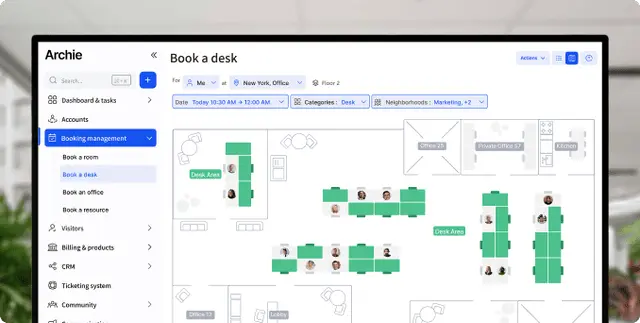
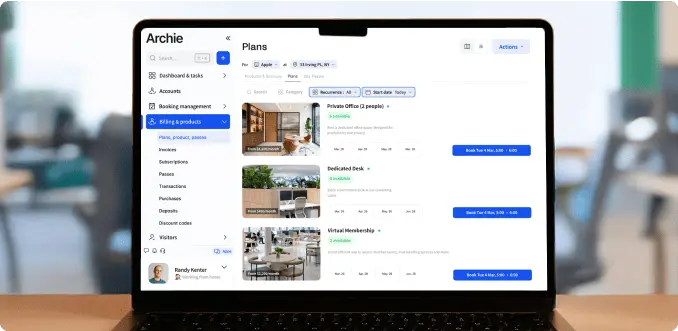
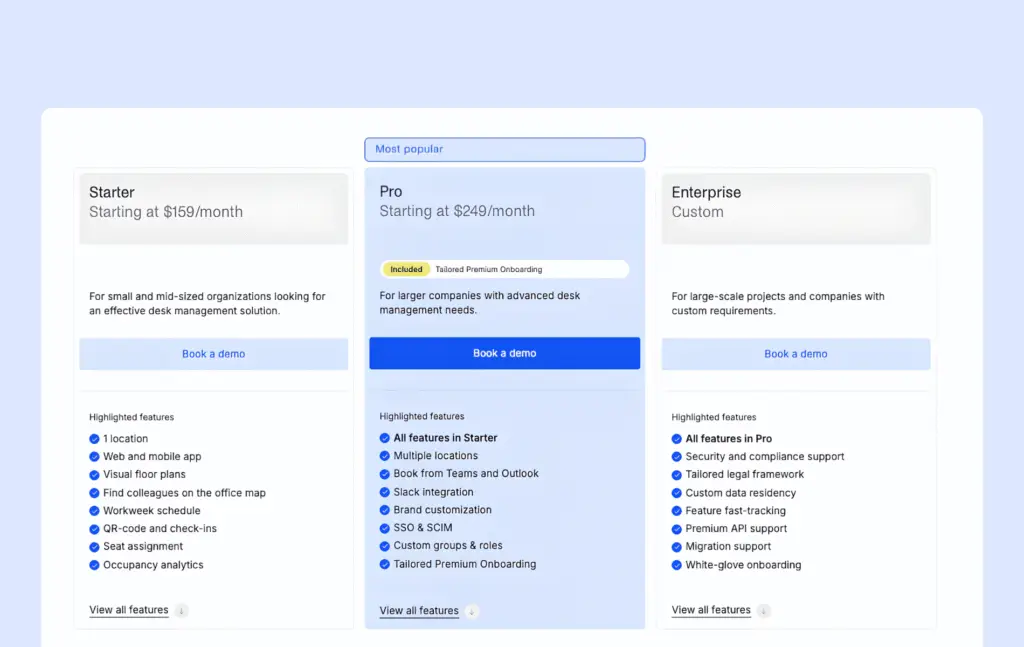
- Archie charges per desk. The minimum price is $159/month, which can include over 50 desks (depending on meeting room additions).
- Envoy Reservations is $60 per bookable resource/year + platform fees.
- Eden charges $2.25 per desk/month, sold in sets of 25.
- Skedda is also “space-based,” but in tier bundles.
If you have more people than desks, per-desk pricing is usually the easiest to live with.
#2 Per user (or per active user)
You pay for each employee who uses the tool (or is counted as “active”).
Why it can get expensive: In hybrid teams, many people need access even if they come in only once a week. That can push up costs quickly.
Examples:
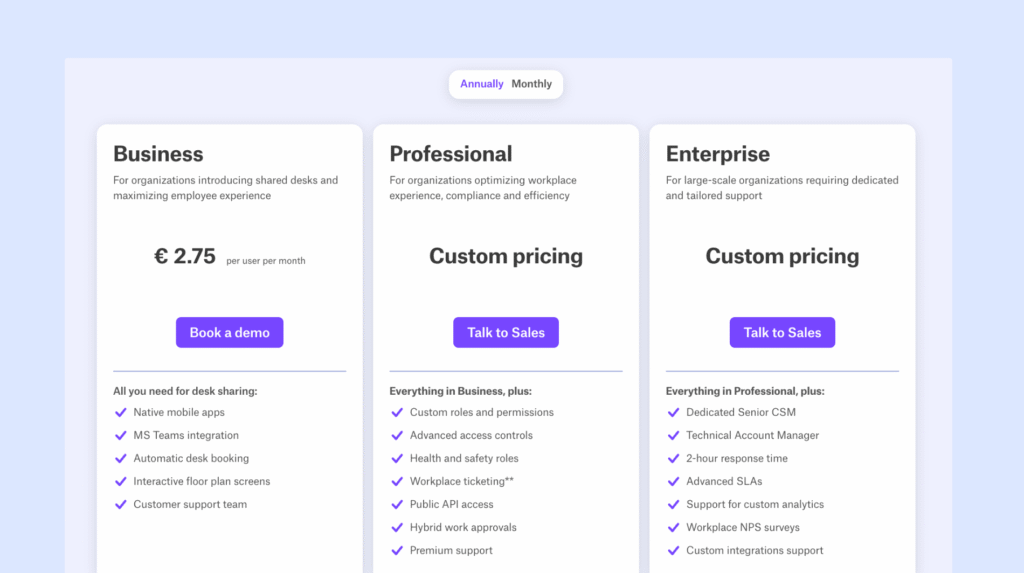
- deskbird: costs about $3.75 per user/month (when billed annually), depending on tier
- Officely: $2.50 to $3.50 per user/month
If you are a small office where almost everyone has a seat, per-user pricing can be totally fine.
#3 Quote-based enterprise pricing
You do demos, share your requirements, and get a custom quote.
Why it exists: Enterprise tools often sell larger rollouts with onboarding, security, SLAs, and complex integrations.
Examples:
Pricing typically starts around enterprise levels, often reported around $5,000+ per year. If your office is complex (many locations, strict security, advanced analytics), quote-based pricing can make sense, but expect extra friction.
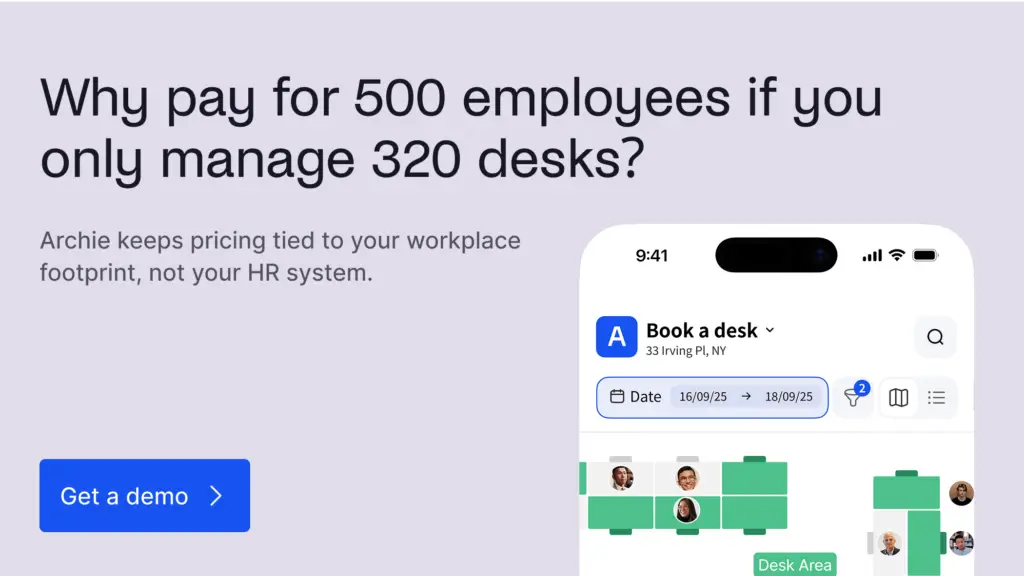
💡 A quick way to decide which pricing model is best for your setup:
- If you have more people than desks, per-desk pricing is usually the easiest to live with.
- If you are a small office where almost everyone has a seat, per-user pricing can be totally fine.
Does a free desk booking system exist?
Yes, free desk booking software exists, but it usually means “free for small teams” rather than “free forever for any size.”
Most desk booking tools make money when a company grows. So the free version is often designed as a starting point. It helps you test the basics, roll it out to a small group, and see if people actually use it. Once you need more users, more offices, or more control, you normally move to a paid plan.
Still, there are a few different types of “free” desk booking software:
- Free plans (freemium). Some vendors offer a truly free plan you can use for as long as you want. The catch is that it comes with limits, usually around the number of users, office locations, or specific features you get. For example, deskbird positions its free plan as a way for small teams to get started, and then you upgrade as your needs grow. In real life, this is usually enough to test the experience, but not enough to run desk booking across a full office.
- Free trials (try before you buy). Many tools do not offer a free plan, but they do offer a free trial. This is different from freemium because the trial is time-limited, like 7, 14, or even 30 days. Trials are great when you want to test the “real” product, not a stripped-down version. The downside is that you need a plan for what happens when the trial ends, especially if people start relying on it.
- Desk booking via Excel/Google Sheets. Alternatively, you could also go for a free hot desk booking template and use Excel/Google Sheets for desk bookings.
💡 Keep in mind that user limits show up fast. A plan that works for 10 to 15 people can break the moment you try to include one full team, one department, or the whole office. The free plan may be missing the features and admin controls that actually make desk booking work. Plus, with free plans, support is often slower or more self-serve. That’s fine for testing, but it can be risky if the tool becomes business-critical.
What usually increases the desk booking software price
- More locations and floors. Once you move beyond a single office, costs often go up. Multi-location support, extra floors, or separate buildings are commonly tied to higher plans or add-ons.
- SSO, SCIM, directory sync. Single sign-on and user provisioning sound basic, but many tools treat them as “advanced” features. They are often locked behind higher tiers, especially in per-user pricing models.
- Admin controls. The more control you need, the more you usually pay. Things like approvals, role-based access, desk neighborhoods, booking limits, buffers, and restrictions are often only available in paid or higher plans.
- Analytics depth. Most tools include basic dashboards. But if you want longer data history, exports, custom reports, or more detailed desk occupancy insights, that typically comes at an extra cost.
- Integrations. Some platforms include desk booking integrations like Microsoft 365 or Slack booking early on. Others reserve these integrations for higher tiers, even though many teams see them as essential.
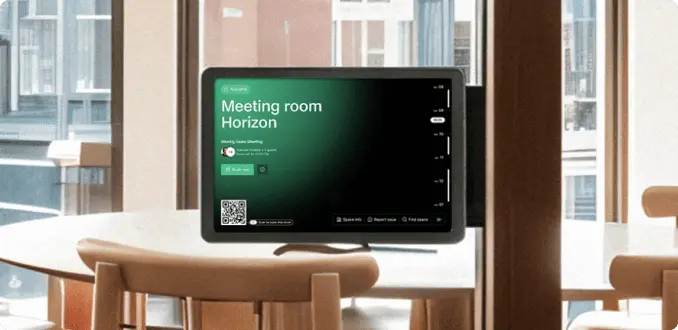
- Extra modules. Visitors, parking, workplace requests, AI assistants, desk booking kiosks, and room displays can add cost quickly.
💡 When comparing desk booking tools, always look past the starting price. Check what’s actually included at that tier, and what you’ll need to pay for once your office setup gets a bit more complex. The most common things to watch for are minimum monthly fees, bundles or tiers that force you to overbuy, key features locked behind higher plans, and unclear “active user” billing where “active” can mean different things depending on the vendor.
Desk booking software pricing comparison
Here’s an exemplary desk booking software pricing comparison for 100 desks and 200 employees, charged per month in US dollars:
Software | Est. monthly cost | Plan used for comparison | Pricing model | Pricing math |
|---|---|---|---|---|
Archie | $280 | Starter | Per desk | 100 desks × $2.80 |
Officely | $500 | Basic | Per user | 200 users × $2.50 |
Eden | $225 | Accelerate | Per desk (sold in bundles) | 100 desks × $2.25 |
deskbird | $750 | Business | Per user | 200 users × $3.75 |
YAROOMS | $699 | Business | Tiered by users | Tier that covers ~200 users |
Dibsido | $380 | Growth | Per user | 200 users × $1.90 |
Envoy Reservations | $500 | Reservations | Per resource | 100 desks × ~$5.00 |
A simple way to estimate your monthly desk booking cost
You can get a pretty good estimate with four numbers:
- How many employees need access? Even occasional office users usually need access to book.
- How many desks will be bookable? Count only what will actually be reserved in the tool.
- How many locations and floors? Multi-site support can push you into different tiers.
- What are your “non-negotiables”? For many teams, that includes SSO, Microsoft Teams, or Slack, check-ins, analytics, and admin rules.
Once you have those, compare desk booking software pricing like this:
- If a tool is per user, multiply the per-user price by the number of users who need access.
- If a tool is per desk, multiply the per-desk price by the number of desks you will manage.
- If a tool uses tiers, check what happens when you exceed the included limits.
If you want a desk booking system that is easy to use, easy to roll out, and easy to budget for, Archie is a strong pick for most modern offices. It charges per desk, not per employee. That means your cost is tied to the number of desks you actually manage, which usually changes much slower than headcount in a shared-desk office.
At the same time, if you are a smaller team and you just need something lightweight, a per-user tool can still make sense, especially if you care most about quick setup and fast adoption. The main tradeoff is that per-user pricing often gets expensive later as more people need access, even if they only come in once or twice a week.
How to measure ROI of desk booking software
The easiest way to calculate the ROI of desk booking software is to compare the cost of the system with the value it creates through better desk usage, fewer ghost bookings, less admin work, and faster desk reservations.
In many hybrid offices, desk availability can be hard to understand without the right data. Employees may book desks and not show up, forget to cancel a reservation, or reserve a desk “just in case.” At the same time, admins may think they need more desks than they actually do because they are relying on bookings instead of real usage.
Desk booking software helps reduce this waste with check-ins, booking reminders, automatic desk release, occupancy analytics, and clear visibility into who is coming into the office.
A simple ROI formula looks like this:
ROI (%) = ((Annual benefits – Annual costs) / Annual costs) × 100
For example, let’s say your company has 100 bookable desks and 200 employees. If 20% of desk bookings are no-shows, that means 20 desks may be reserved but unused on a typical busy day.
If each desk costs around $3,000 per year to maintain, including rent, utilities, furniture, cleaning, and other workplace costs, the annual value of those unused desks could be:
20 desks × $3,000 = $60,000 per year
If automated check-ins, reminders, and desk auto-release reduce that waste by 50%, the company could recover:
$60,000 × 50% = $30,000 per year
You can also add employee time savings. For example, if 200 employees save just 5 minutes per week because they can find and book desks faster, that adds up to 867 hours saved per year.
200 employees × 5 minutes × 52 weeks = 52,000 minutes
52,000 minutes / 60 = 867 hours
At an average employee cost of $40 per hour, that time is worth:
867 × $40 = $34,680 per year
Then, add admin savings. If an office manager saves 4 hours per week on desk questions, seating conflicts, manual updates, and occupancy reporting, at $35 per hour, that equals:
4 hours × 52 weeks × $35 = $7,280 per year
So, if you add it all up, the total annual benefit would be:
$30,000 + $34,680 + $7,280 = $71,960 per year
Now compare that with the cost of the software. Let’s say you’re using Archie, and your desk booking software costs $280 per month for 100 desks. The annual software cost is:
$280 × 12 = $3,360 per year
Using the ROI formula:
(($71,960 – $3,360) / $3,360) × 100 = 2,042% ROI
Of course, this is only an example. Your actual ROI will depend on your desk count, employee attendance patterns, no-show rate, real estate costs, software pricing, and how much unused desk space the system can realistically reduce.
The main point is that desk booking software often pays for itself by helping companies make better use of the desks they already have. Instead of adding more desks or expanding office space, teams can reduce ghost bookings, release unused desks automatically, improve booking habits, and use real data to understand how much office space they actually need.