







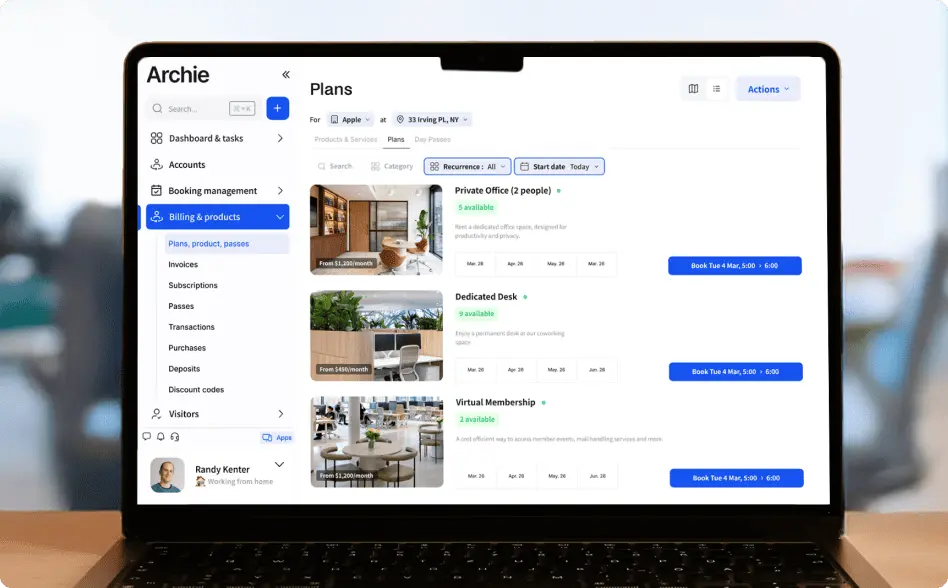



- What you’ll learn
- The real difference between Nexudus vs OfficeRnD Flex
- What each tool does well (and where operators commonly get frustrated)
- How pricing actually works, including the add-ons that can raise your total cost
- When it makes sense to pick Archie instead
Two coworking platforms. A dozen comparison articles that all say the same thing. And you’re still not sure which one to pick.
We’ve been there; digging through feature lists, pricing pages that raise more questions than they answer, and reviews that feel suspiciously positive. So we wrote the Nexudus vs OfficeRnD comparison we wish existed when we started researching coworking management software.
The short version: Both are good. Neither is cheap. And depending on your space, you might be better off with something else entirely. We’ll break down where each platform actually wins, where they’ll frustrate you, and why Archie keeps showing up in conversations about switching away from both.
What is Nexudus?
Nexudus is a London-based coworking workplace platform serving 2,000+ spaces across 90+ countries. People call it the “Salesforce of coworking,” which is accurate in ways both flattering and not. It’s powerful, it can do almost anything, and it takes a while before you stop feeling lost in it.
Billing automation, bookings, member CRM, visitor management, space management, and analytics. The platform tries to cover every operational angle a coworking space might need, and mostly succeeds.
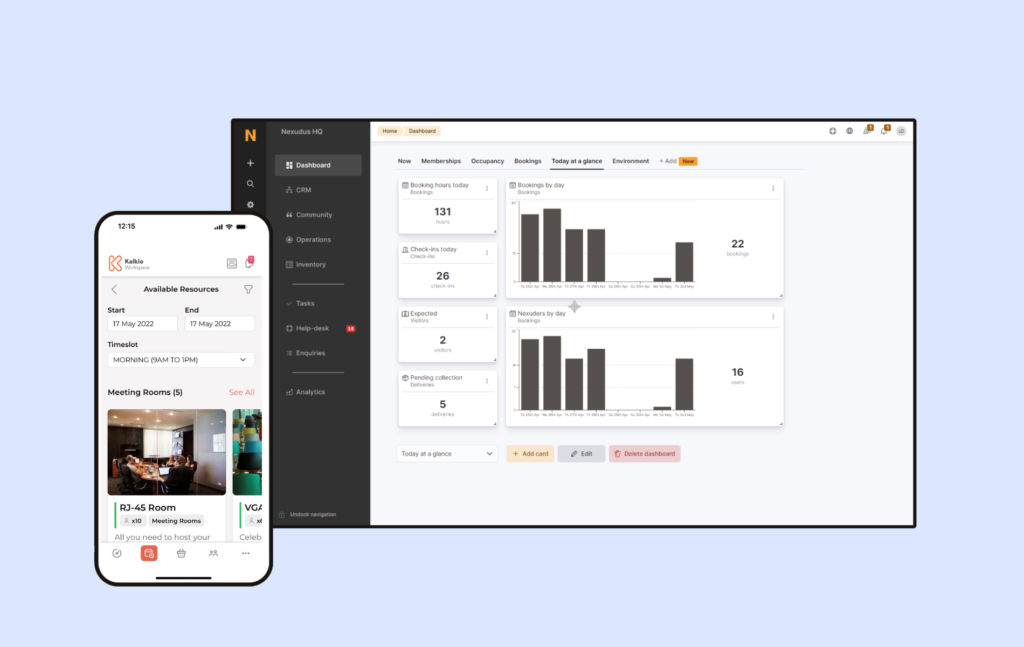
Nexudus core features
Billing is the crown jewel. 100+ payment processors, multi-currency, proration, credits, dynamic pricing. If your billing setup is complicated (think multiple currencies, weird prorating rules, a dozen payment gateways), Nexudus handles it better than most coworking space management platforms.
Booking works well. Customers reserve rooms and desks through the web portal or mobile app, with dynamic pricing and flexible cancellation policies. There’s also an external booking platform for walk-ins and day passes. Solid, if not flashy.
Where Nexudus really separates itself is the white-label setup. Passport app for iOS/Android, NexIO for front-desk tablets, NexBoard for visitor kiosks, and full HTML/CSS access to the member web portal. That last part matters. Most competitors give you a color picker and a logo upload. Nexudus gives you the code. We go deeper on this in our white-label coworking software guide.
Member management covers the full lifecycle: CRM, lead tracking, membership plans, contracts, and documents. Reporting ships deep, and the optional Explore Pro module adds custom dashboards and AI predictions for extra cost. If data matters to you, budget for it. Integrations are strong: 80+ native connections (HubSpot, Zapier, QuickBooks, Slack, Microsoft Teams, access control, WiFi, printing), plus a REST API and SSO.
Who Nexudus is best for
Nexudus is best for large, multi-location coworking operators with complex billing who don’t mind a steep onboarding process. If you need full brand control and deep configurability, Nexudus can definitely deliver.
Our full Nexudus software review goes into the trade-offs.
What is OfficeRnD?
OfficeRnD started in 2015 in Sofia, Bulgaria, and has since expanded with offices in Atlanta, Dallas, Melbourne, and London. It has two main products: OfficeRnD Flex for coworking and flexible workspaces, and OfficeRnD Workplace for corporate offices managing hybrid bookings and workplace policies. In this review, we’re focusing on Flex.
Flex organizes the platform into five “hubs”: Operations, Experience, Growth, Visitor, and Integrations. Each hub covers a clear part of running your space, which helps keep things tidy as your setup gets more complex. It’s a more guided approach than Nexudus, which offers a bigger set of coworking tools, but leaves more of the structure and setup to you.
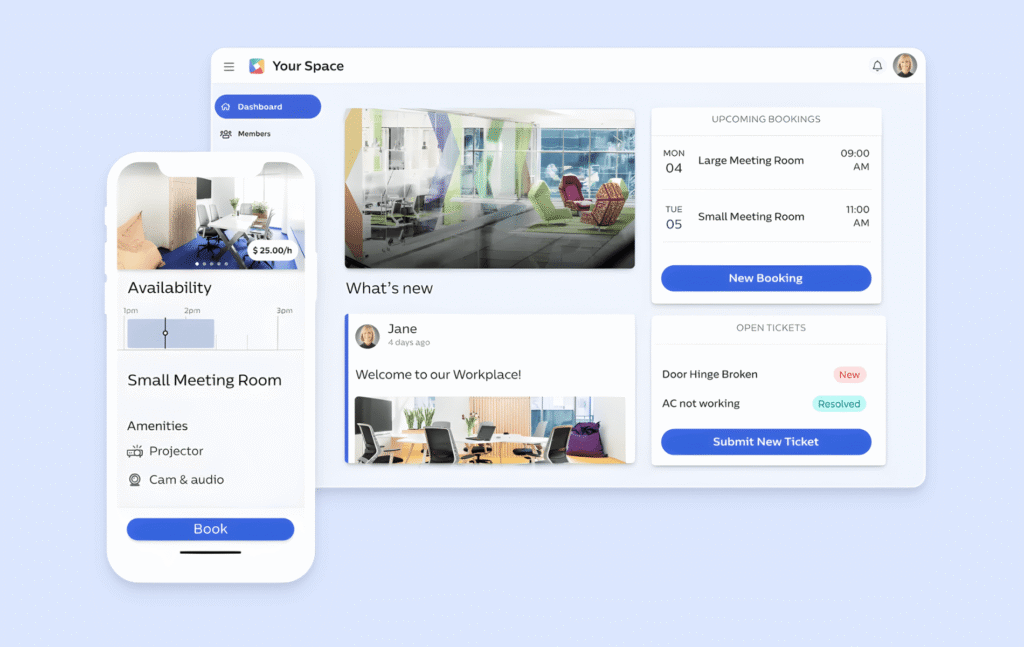
OfficeRnD Flex core features
Operations Hub is the backbone, with member lifecycle, billing, invoicing, payments, booking, and coworking inventory. Integrates with Xero, QuickBooks, Sage Intacct, as well as SSO and SCIM provisioning for enterprise setups.
Experience Hub is where OfficeRnD stands out from most competitors. White-label member app and member portal, community features (likes, comments, posts, email announcements), and a member experience that feels genuinely modern. Member privacy controls add a security layer that’s often missing elsewhere.
Growth Hub deserves its own mention. It’s a self-serve booking engine you embed on your site, so that prospects browse available office space, book, pay, done — no staff involvement. The only downside is that OfficeRnD takes a commission on every purchase made via the Growth Hub.
Visitor Hub covers check-in and delivery management, while the Integrations Hub offers 50+ native connections (Microsoft Teams, Microsoft 365, Slack, Google Calendar), open API, and SSO via Okta and Azure AD on higher-tier plans.
Who OfficeRnD Flex is best for
OfficeRnD is best for growing operators who want a polished space management platform without months of setup. OfficeRnD Flex gets you live faster. The separate OfficeRnD Workplace product targets corporate hybrid workplace management — a different audience, a different feature set.
The complete OfficeRnD Flex review goes into the details.
Nexudus vs OfficeRnD: Feature-by-feature comparison
Billing and payments
Nexudus: ★★★★★ | OfficeRnD: ★★★★☆
Nexudus, and it’s not close. 100+ payment processors, multi-currency, dynamic pricing, and invoicing that operators call rock-solid. OfficeRnD connects to Stripe, Xero, QuickBooks, Sage Intacct — capable, but billing workflows are still maturing.
Booking
Nexudus: ★★★★☆ | OfficeRnD: ★★★★★
OfficeRnD wins. The Growth Hub turns your coworking space website into a storefront (but charges extra for it), and the app is noticeably more polished to use. Nexudus counters with dynamic pricing for bookings (OfficeRnD added that later in 2025).
Member experience
Nexudus: ★★★★☆ | OfficeRnD: ★★★★★
OfficeRnD’s member tools look and feel modern. Community features create real engagement among members. Nexudus gives you deeper customization through HTML/CSS portal access, but the default UI is a bit older.
Reporting
Nexudus: ★★★★☆ | OfficeRnD: ★★★★☆
Nexudus goes deeper with granular reports and the optional Explore Pro module, but it charges extra for it. OfficeRnD’s reporting hub is powerful, but operators who need complex financial forecasting say it comes up short.
Integrations
Nexudus: ★★★★★ | OfficeRnD: ★★★★☆
80+ native integrations vs. 50+, plus 100+ payment gateways. Both have APIs. SSO support on both — Nexudus uses SSO via SAML, OfficeRnD offers SSO through Okta and Azure AD. If your organization has specific compliance policies, check each vendor’s trust center.
Onboarding
Nexudus: ★★★☆☆ | OfficeRnD: ★★★★☆
The gap everyone talks about. OfficeRnD is more efficient to use from week one — cleaner interface, hub-based navigation, structured onboarding. Nexudus often requires paid training on top of setup. Neither is plug-and-play, but OfficeRnD gets you there a little faster.
Nexudus vs OfficeRnD: Pricing comparison
Nexudus pricing
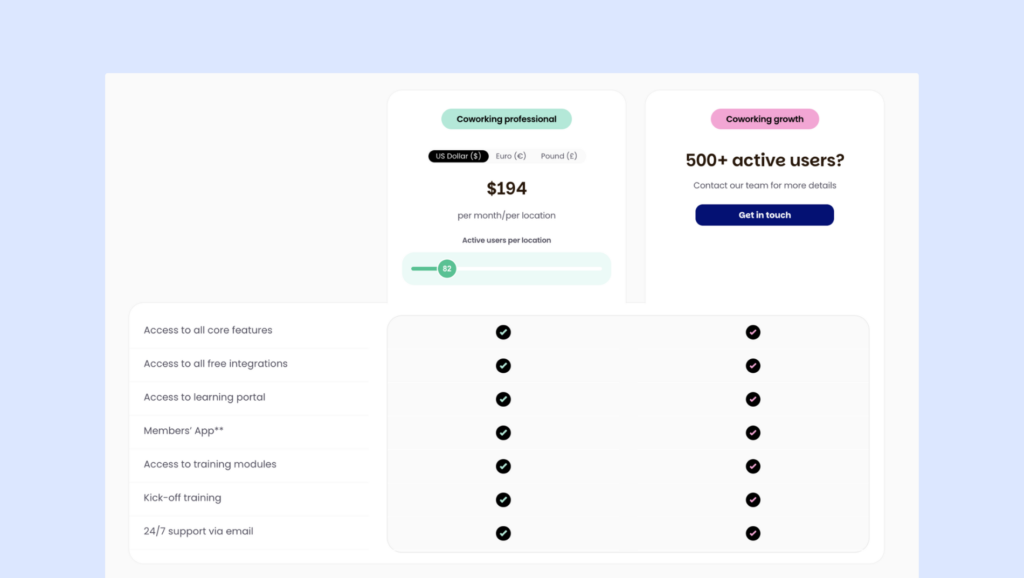
Per location, based on active member count. Starts at $150/month for up to 80 members. Then: $10/month per payment gateway, $0.04 per transaction, $150/month for white-label Passport (up to five locations). SSO included. 21-day trial.
OfficeRnD Flex pricing
Per-location, tiered. There is no transparent pricing on their website — plans used to start at around $165/month for a single location with 100 members, including all core features and standard integrations. According to Software Advice, the Start plan is around $185/month (one location, up to 100 members), and Grow starts at $219/month. Enterprise is custom.
When asking for a quote, check what hubs/modules are included and which ones cost extra. For example, Growth Hub adds public purchase pages to your website so people can browse, book, and pay online. That is great, but make sure you understand any transaction fees or commission that may apply to purchases.
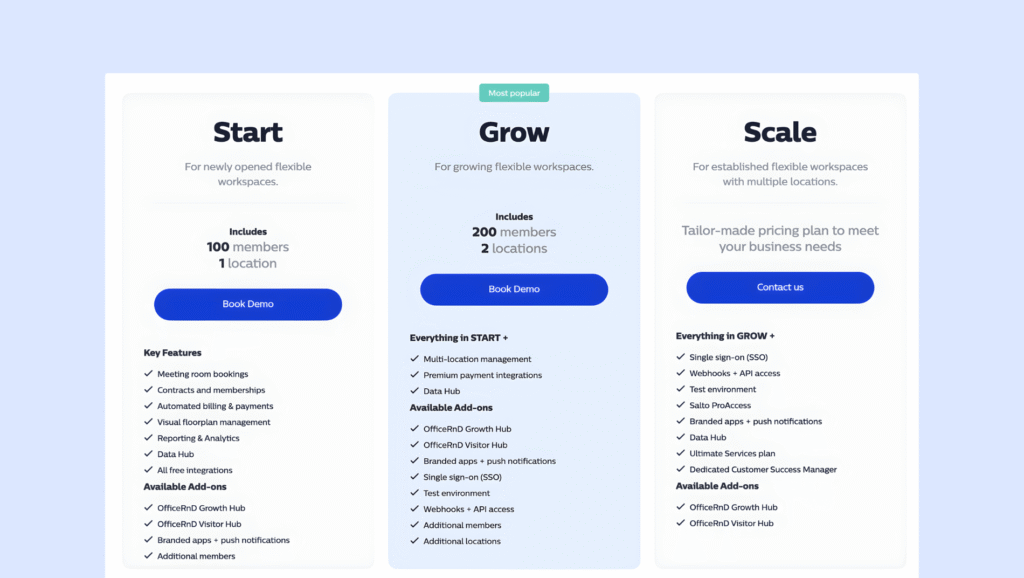
There’s also a 14-day trial, and three months free if switching from another platform.
Value analysis
Total cost of ownership is what catches people off guard. Analytics add-ons, SSO upgrades, support packages, maybe a Nexudus consultant — it stacks up quickly. You need to understand what the total really looks like before signing. Nexudus scales with your member count; OfficeRnD uses fixed tiers. Both target mid-market and up.
Recent coworking statistics show that many spaces still struggle to achieve profitability. Coworking software costs are one of the few line items you can actually control.
Nexudus vs OfficeRnD: User reviews and ratings
What coworking operators say about Nexudus
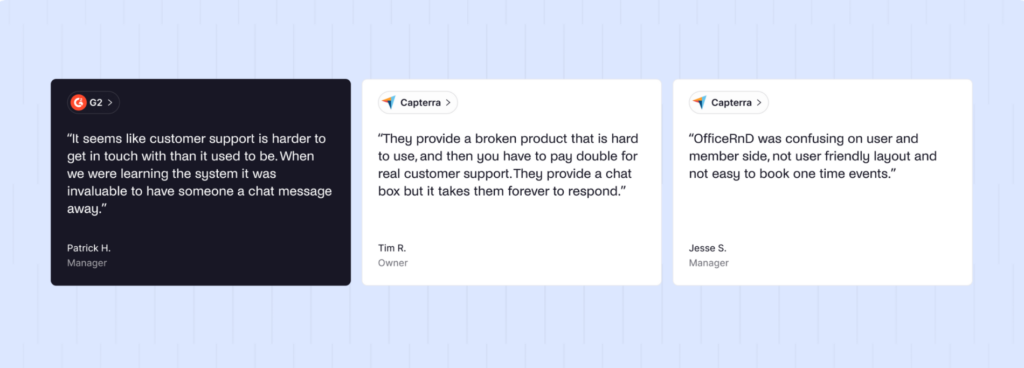
3.7/5 on Capterra from six reviews — tiny sample, hard to draw much from. G2 is warmer. The billing engine gets consistent praise, and operators who’ve been on the platform for years appreciate the depth.
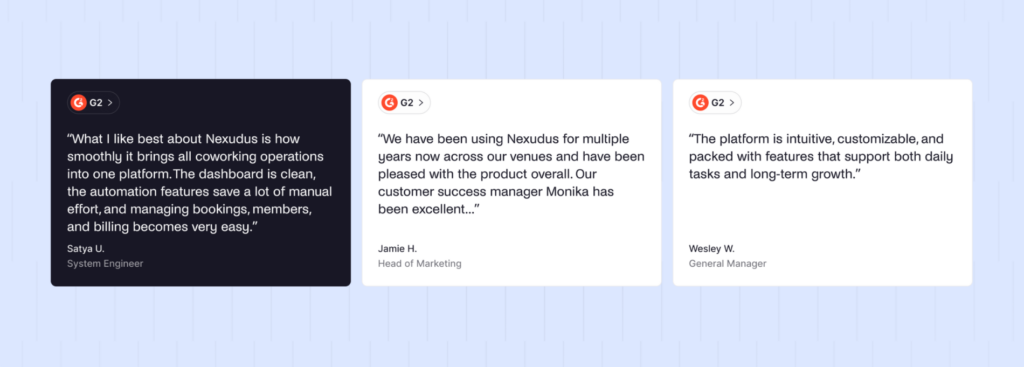
The complaints recur across every review site: a steep learning curve, an admin interface that feels outdated, a CRM that creates duplicate contacts when leads become members, and integrations that don’t always cooperate at launch.
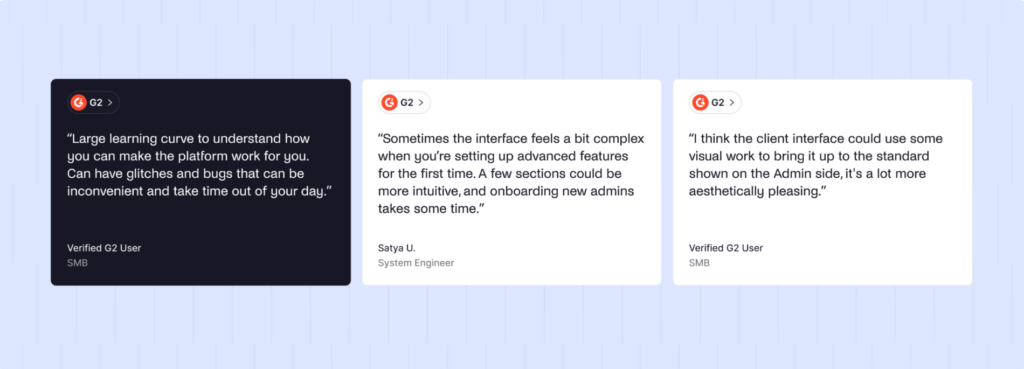
What coworking operators say about OfficeRnD
4.5/5 on Capterra, 31 reviews. G2 is positive too. People like the interface, the hub structure, and the pace of new features.
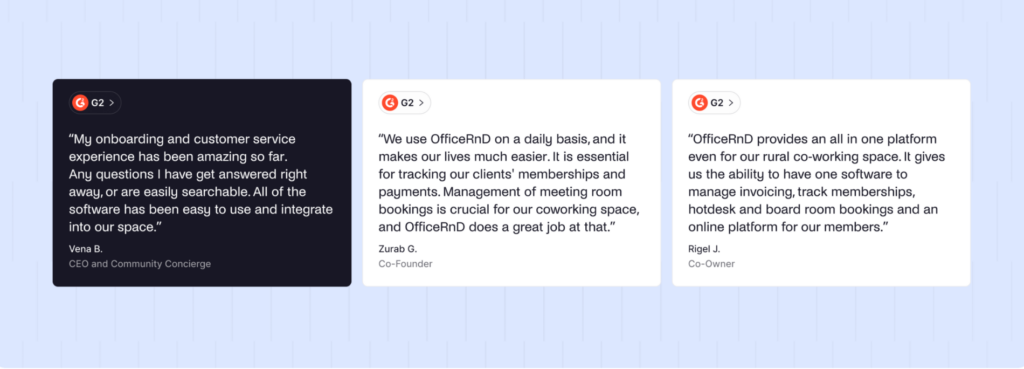
The pattern in negative reviews: operators love how it looks, then hit billing limitations or a support gap at the worst possible time. White-label pricing also surprises people who didn’t notice the fine print.
Nexudus vs OfficeRnD: Pros and cons
Nexudus pros and cons
🟢 Pros:
- Billing engine is really powerful: 100+ payment processors, multi-currency, dynamic pricing
- Full HTML/CSS control over the member web portal — real brand ownership, not just a logo upload
- 80+ native integrations
- 12+ years in the coworking software industry — they’ve seen every weird edge case your space might throw at them
🔴 Cons:
- The learning curve is real — as mentioned in the Coworking Owners Alliance group, some operators hire consultants just for the initial setup
- The admin interface hasn’t had a meaningful redesign in a long time
- Explore Pro module and white-label tools are paid extras, and they add up fast
OfficeRnD Flex pros and cons
🟢 Pros:
- The interface looks like it belongs in 2026: clean, organized, hub-based
- Hub-based navigation keeps the whole experience structured and easy to follow
- Growth Hub, a self-serve booking engine you embed on your website, is a real revenue tool (but there’s a commission you have to pay)
- Faster onboarding than Nexudus
🔴 Cons:
- 50+ integrations vs. Nexudus’s 80+, and some newer ones may feel rushed to market
- White-label tools are an add-on that gets expensive
- Reporting won’t satisfy operators who need deep financial forecasting
- Judging by user reviews, customer support experience varies
A third option worth considering: Archie
Nexudus and OfficeRnD are both powerful platforms. They can handle complex setups, deep configuration, and advanced reporting. But for many operators, that “power” comes with tradeoffs: longer setup, more training, and more day-to-day admin.
You can find multiple alternatives to OfficeRnD or alternatives to Nexudus, but there’s one option that stands out: Archie’s coworking software.
You get up and running faster
Archie Coworking is built for quick deployment. If you do not have a dedicated IT person or an operations specialist, that matters a lot. You can launch memberships, bookings, billing, and visitor flows without weeks of configuration.
With Nexudus and OfficeRnD, you can usually do more “under the hood,” but it can take longer to set up properly, especially if you want everything configured perfectly from day one.

The UI is more modern and easier for people to learn
This is the biggest reason teams switch. Archie is designed to feel clean and intuitive, so staff and members need less training and tend to submit fewer support requests.
If you are choosing between “maximum configurability” and “a product people will happily use,” Archie usually wins on adoption. You even see that reflected in user feedback, like Archie’s high Ease of Use scores on G2.
You still get the core coworking features, without the complexity
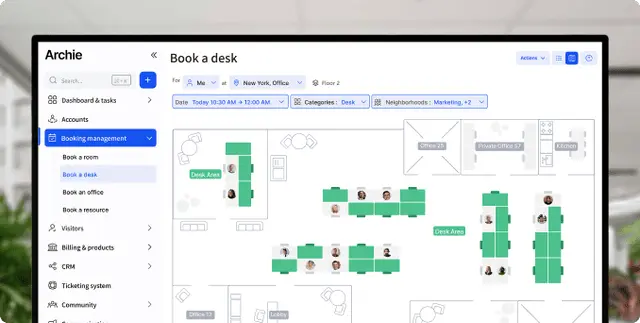
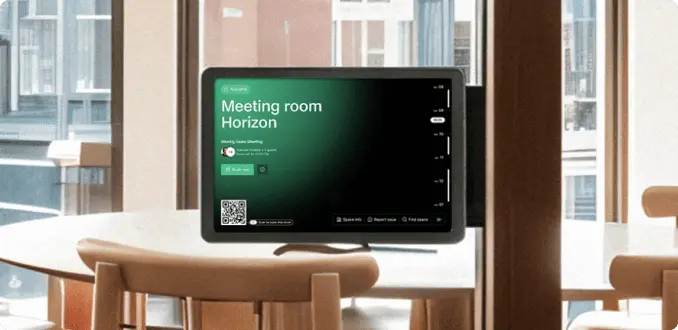
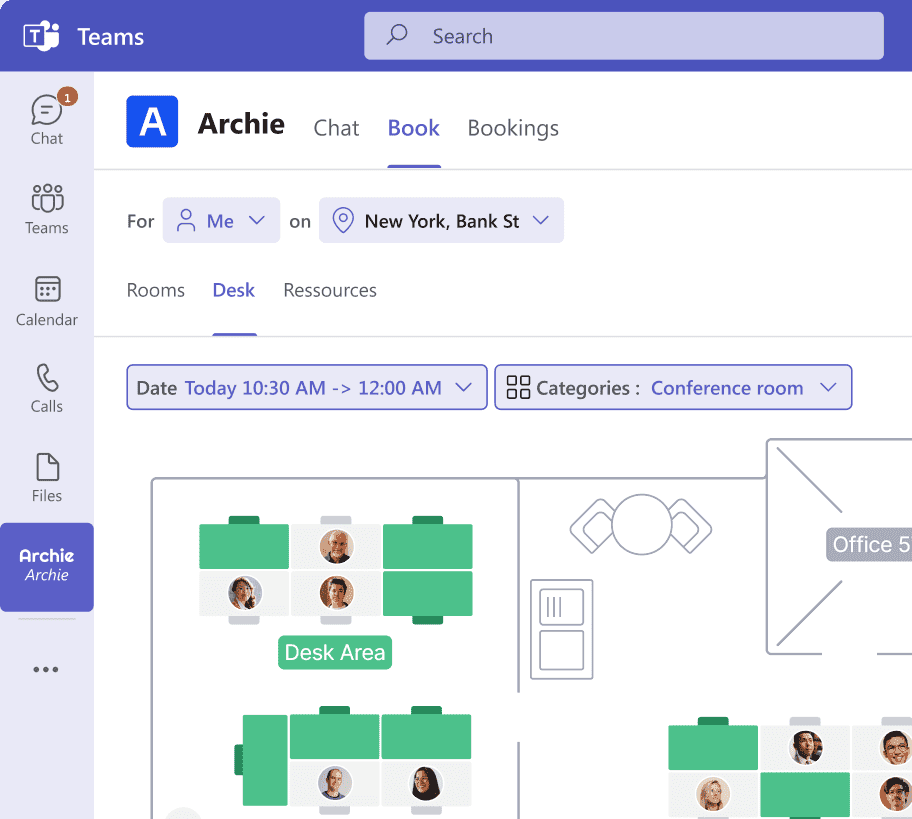
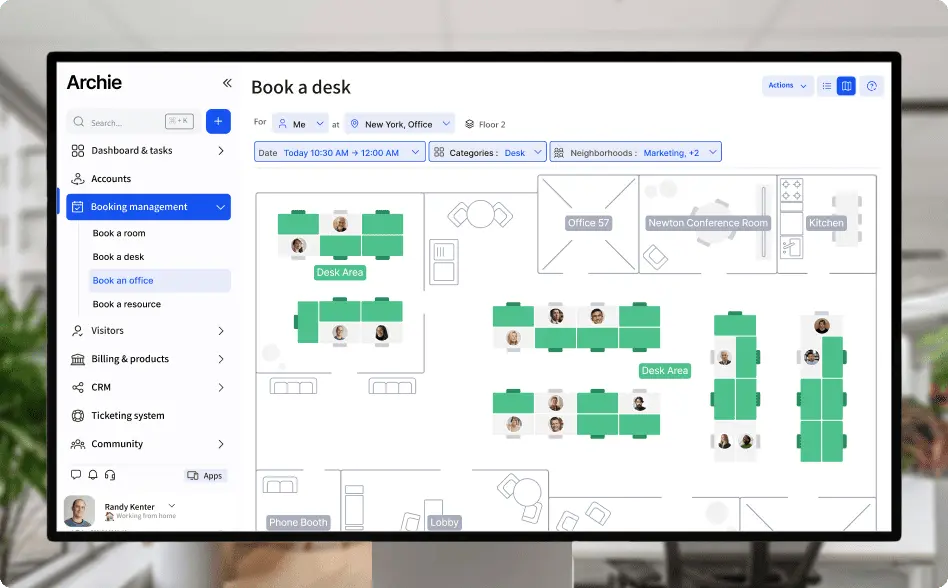
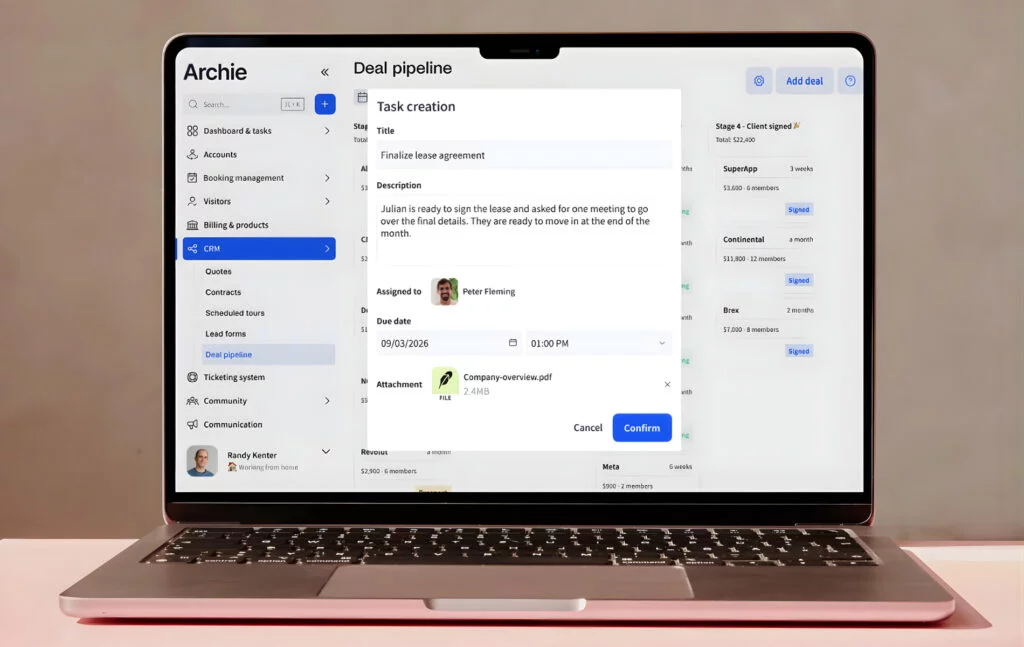
For most spaces, Archie covers the essentials very well: memberships, automated billing, CRM, a coworking booking system with interactive floor plans, visitor check-in on iPad and Android, community tools, analytics, and a white-label member app option.
Nexudus can be a better fit if you need very deep customization, and OfficeRnD can be a better fit if you need advanced reporting and complex multi-site KPI analysis. But many operators do not need that extra depth day to day. They just want a system that works, is easy to manage, and looks professional.
Pricing is easier to understand and plan around
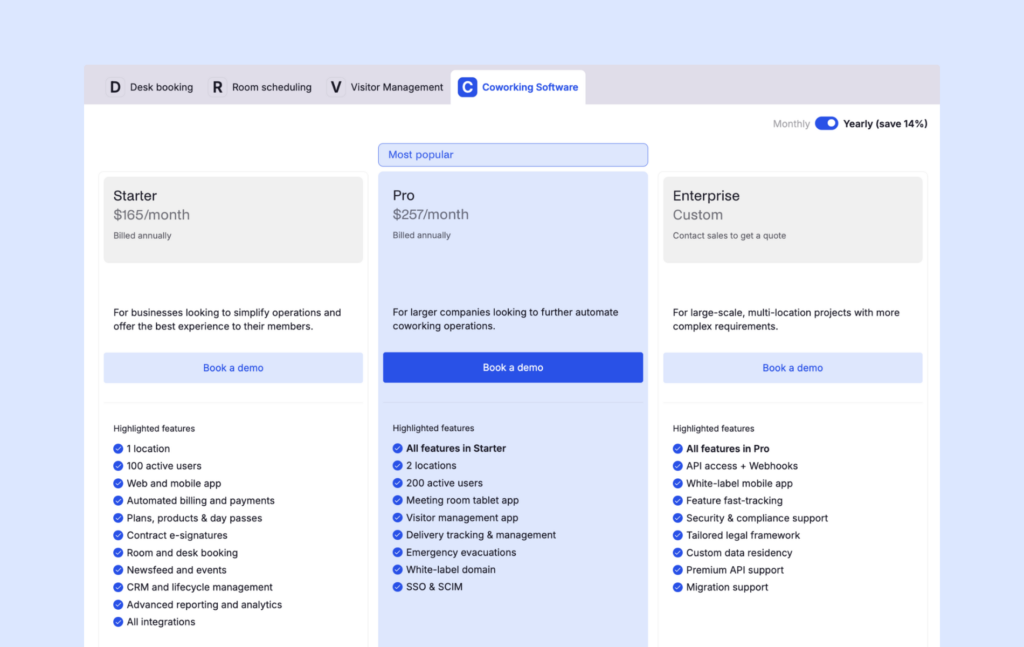
A big reason operators prefer Archie is predictable pricing. You know what you are paying, what is included, and what add-ons exist (like the white-label app), without worrying about a long list of upgrades or extra commissions.
That is especially helpful when you are budgeting for growth, adding locations, or trying to keep software costs stable as your member count changes.
Archie Coworking plans start at $165/month for up to 100 active members.
Integrations are strong, and you can still build your stack
Even if Archie is simpler to use, you are not boxed in. You can connect to lots of tools natively, through Zapier, or use the open API to build custom workflows if you need them. That gives you flexibility without forcing you into a complicated setup upfront.
💡 Bottom line: If you want the deepest reporting and enterprise complexity controls, OfficeRnD can make sense. If you want a huge toolbox and heavy customization, Nexudus can be a good fit.
But if your priority is a modern experience, fast setup, easy onboarding, and clear pricing, Archie is often the better option. Here are more detailed Archie vs OfficeRnd and Archie vs Nexudus comparisons.
Archie vs Nexudus vs OfficeRnD: Which should you choose?
All three platforms can run a serious coworking business. The best choice comes down to what you value most: simplicity and speed, deep billing and customization, or a structured “all-in-one” setup with strong reporting:
Choose Archie if...
- You want one platform that covers the essentials in one place: memberships, bookings, billing, visitor management, and community.
- You care most about ease of use for both staff and members, with less training and fewer support tickets.
- You want a faster rollout without needing a consultant or a heavy setup phase.
- You are switching platforms and want help with onboarding and migration, so the move feels less painful (our coworking software migration guide can set expectations).
Choose Nexudus if...
- Billing flexibility is non-negotiable (multi-currency, dynamic pricing, and lots of payment processor options).
- You want full HTML/CSS control over your member web portal.
- Your team has the time and budget for deeper setup, training, and possibly outside help.
- You run a large, complex, multi-location operation and need very granular reporting.
- You want the widest selection of native integrations in coworking software.
Choose OfficeRnD Flex if…
- You want a modern interface that admins and members enjoy using.
- Structured onboarding and a faster go-live matter more than maximum configurability.
- A self-serve booking engine on your website (via the Growth Hub) would help you fill desks and rooms.
- You like the “hub” structure (Operations, Experience, Growth, Visitor, Integrations) because it keeps the platform organized and easier to navigate.
- You are migrating from another platform and the 3-months-free offer makes the switch easier.
Archie vs Nexudus vs OfficeRnD: Comparison table
Feature | Archie | Nexudus | OfficeRnD |
|---|---|---|---|
Starting price for 100 active users | $165/mo per location | $194/mo per location | Custom pricing |
Free trial | 14 days | 21 days | 14 days |
Billing engine | ★★★★☆ | ★★★★★ | ★★★★☆ |
Booking | ★★★★★ | ★★★★☆ | ★★★★★ |
Member tools | ★★★★★ | ★★★★★ | ★★★★★ |
Reporting | ★★★★☆ | ★★★★★ | ★★★★★ |
Visitor management | ★★★★★ | ★★★★★ | ★★★★★ |
Speed & ease of setup | ★★★★★ | ★★★☆☆ | ★★★★☆ |
White-label app | $90/month | $150/month | Custom pricing |
G2 rating | 4.9/5 | 4.2/5 | 4.6/5 |
Final verdict
Most coworking operators will never use everything Nexudus can do. That is not a criticism. Nexudus is built for complex, multi-location businesses where things like multi-currency billing and deep portal customization really matter. If you run that kind of operation, Nexudus is usually the right pick.
OfficeRnD Flex is a strong middle ground if you want a modern platform that is easier to work with day to day, without a long setup process. The member and admin experience feels polished, and the Growth Hub can be genuinely helpful for filling desks and rooms. Just make sure you understand the full cost once you add extras like white label tools and SSO.
Archie is the simplest choice for most mid-sized coworking spaces. You get predictable pricing, fast onboarding, SSO included, and the core workflows in one place: memberships, bookings, billing, visitors, and community. If you want something you can roll out quickly and your team will actually enjoy using, Archie is a great fit.
Nexudus vs OfficeRnD FAQs
Nexudus is built for configurability — 80+ integrations, 100+ payment gateways, full HTML/CSS web portal customization. OfficeRnD Flex prioritizes usability with a cleaner interface and structured onboarding. OfficeRnD also offers a separate OfficeRnD Workplace product for corporate offices and hybrid workplace management.
OfficeRnD Flex, by a wide margin. Nexudus has a steep learning curve — some operators hire consultants for setup. Once you get through it, Nexudus offers unmatched flexibility.
Nexudus starts at $150/month per location (up to 80 members). OfficeRnD Flex starts around $185/month. Both charge extra for white-label tools. Nexudus offers a 21-day trial; OfficeRnD offers 14 days plus three months free when migrating.
OfficeRnD offers the dedicated OfficeRnD Workplace product for corporate hybrid workplace management, with booking for employees and Microsoft Teams integration. Nexudus focuses on coworking but handles flexible setups. Archie supports both flexible offices and coworking spaces.
- Key sources